Tuesday, September 25, 2007

Wal-Mart Asks: How Much Energy Does it Take to Make Toothpaste?

Wal-Mart Stores Inc. (WMT) on Monday said it formed a partnership with the Carbon Disclosure Project to measure the amount of energy used to make products throughout its supply chain.

Wal-Mart said it will use this measurement tool to initiate a pilot plan with a group of suppliers to look for new and innovative ways to make the entire process more energy efficient.

The pilot will focus on seven commonly used product categories - DVD's, toothpaste, soap, milk, beer, vacuum cleaners and soda - and seek to determine the overall environmental impact of products and look for innovative ways to drive energy efficiency.
Interesting. I like it. Can't wait until the day that the labels at the store include the environmental impact of each item.

The project plan of calculating one item in many categories makes a lot of sense to me, but I don't get why they are doing both beer and soda. They are quite similar from an environmental standpoint. Would have liked to see something wood based, maybe books or furniture. And while a vacuum cleaner hits the electronic goods category, I would rather see a TV or a computer in this category.

via CNN Money via Earth2Tech

Read More...

Monday, September 24, 2007

Killing Two Birds With One Stone

According to the All-China Lawyers Association, the country has only 122,000 lawyers. That is 70,000 fewer than California where the population is only 37m (against China's 1.3 billion). Many business people might argue that California is overlawyered, but there are parts of China without any lawyers at all.
This seems like a problem that could easily be solved with 500 one way Los Angeles to Shanghai flights.

via The Economist

Read More...

New Low Cost Solar Panels Ready for Mass Production

Colorado State University's method for manufacturing low-cost, high-efficiency solar panels is nearing mass production. AVA Solar Inc. will start production by the end of next year on the technology developed by mechanical engineering Professor W.S. Sampath at Colorado State.

Sampath has developed a continuous, automated manufacturing process for solar panels using glass coating with a cadmium telluride thin film instead of the standard high-cost crystalline silicon. Because the process produces high efficiency devices (ranging from 11% to 13%) at a very high rate and yield, it can be done much more cheaply than with existing technologies. The cost to the consumer could be as low as $2 per watt, about half the current cost of solar panels.

The process is a low waste process with less than 2% of the materials used in production needing to be recycled. Cadmium telluride solar panels require 100 times less semiconductor material than high-cost crystalline silicon panels.
via Industry Week via Engadget

Read More...

Saturday, September 22, 2007

Telepresence and a Telecommuting Robot

Business travel sucks for a variety of reasons. On a personal level there is jet lag, wasted time, and the hassles such as having to take your shoes off at security checkstands. From an environmental standpoint, travel requires lots of fuel leading to higher greenhouse gas emissions. From a business standpoint it is expensive. For all these reasons, I am hopeful that telepresence can greatly reduce business travel.

The result is something called “telepresence”, which HP and other technology firms are just beginning to sell. It is basically a spruced-up version of videoconferencing, but its creators insist that the technology is so improved as to be unrecognisable. Users still communicate via live audio and video feeds, but the speed and quality of transmission have increased, and the screens have grown and multiplied, in order to create the illusion that the two parties to a conversation are not continents apart but at opposite ends of the same table (as in the picture above).

Designers want people in telepresence meetings to appear life-sized, and the tables and rooms at the two ends to blend together seamlessly. (Rooms, furniture and even wallpaper are often identical, to aid the illusion.) People must also feel that they are making eye contact, which involves multiple cameras and enormous computing power. The delays in sight and sound must be negligible (ie, below 250 milliseconds, the threshold at which the human brain starts to notice), so that people can interrupt each other naturally. Sound must be perceived to come from the direction of the person speaking. And getting things started must be simple—ideally involving a single button or none at all.

HP charges $350,000 for every room it kits out for telepresence and, in America, a further $18,000 a month for service. Cisco charges up to $299,000 per room. Dominic Dodd, of Frost & Sullivan, a research firm, says that buyers of such systems find that despite their high cost they quickly pay for themselves by keeping travel bills down. Cisco claims that it has cut its own spending on travel by a fifth this year, and that the 100-odd telepresence rooms at its own offices around the world are almost constantly in use.

Frost & Sullivan forecasts that the global market for telepresence, although still tiny, will grow by 56% a year to reach $1.24 billion by 2013.
Sounds pretty cool. Hopefully I will get a chance to try it out someday.

And even if you don't have to travel for work, commuting has its own issues of wasted time commuting, traffic (both the headache of being in it and the fact you are adding to it), gasoline costs and CO2 emissions. A recent study estimates that 2.9 billion gallons of fuel wasted in traffic congestion in the US every year. To get around it you can telecommute (which saves 840 million gallons of gas a year), but doing so can make you feel 'out of the loop' at work. Here is one creative solution to that problem:
Programmer Ivan Bowman works from home, but still maintains his presence in the office through the use of a bot he calls IvanAnywhere -- a clever play on his name and the name of his employer, iAnywhere. Basically a webcam-on-wheels, IvanAnywhere motors around the office, takes meetings, and even gives presentations, all while the real Ivan remains safely pantless in his home office.
While that robot will get the job done, I have a feeling that somewhere in Japan scientists are working on making a replacement robot that is a little more lifelike.

via The Economist and Engadget

Read More...

Name Your Own Species

Searching for new ways to raise money for environmental causes, scientists and conservationists are increasingly opting to sell naming rights to the highest bidder.
I think this is a good idea. With possibly 10 million undiscovered species out there, why not help fund their discovery and preservation by selling their names?

And with just 93 shopping days left until Christmas, what better gift can you give someone than the gift of immortality?
The elegant, invitation-only "Blue Auction," hosted by the Monaco-Asia Society and Conservation International under the patronage of Monaco's Prince Albert II, is the boldest sign yet of a novel twist in the centuries-old system for naming new species.
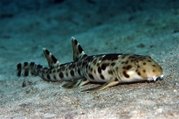
Check out the species that were up for auction. The auction was a success netting $2 million. The shark that walks on its fins went for $500,000 which is good, but not quite GoldenPalace.com monkey good ($650,000).

If you missed the auction, don't worry you still have other options.
A German nonprofit called Biopat has tried a more systematic approach. For the past eight years, Biopat has maintained a database of plants and animals that individuals can name for a price that depends on the species. The group divides the proceeds between the institution of the scientist who found it and support for field projects in the area where it resides. It has raised nearly $514,000 so far for naming rights to about 120 species.
They have a nice selection of species names for sale, including frogs, plants, and one cool looking water mite, for 2,600€ to 3,000€. I personally like the Chilean soft coral for 4,000€ and the Brazilian Nudibranch at 5,000€. Really though, I am holding out for one of these deep sea species to become available.

Aside: I love how this Biopat website is kickin' it vintage 90's style with frames, a web counter and (my all time favorite unnecessary website feature:) a guestbook.

If you already have gifts for all your friends, what about one of your enemies? What better way to have them live in infamy than to name a malaria causing mosquito, a parasitic tapeworm or a slime mold eating beetle (well actually someone thought that last one was an honor) after them?

For those of you with more time then money, hopefully the Encyclopedia of Life will make it easy for amateurs to go discover and name their own species. A handheld species barcoder would certainly make the job easier and might be available some day soon.

And if you were wondering what the latin for Fat Knowledge is, that would be pinguis scientia. A fine name for any species if you ask me. :)

via The Washington Post

Read More...

Can't Tase This


via Digg

Read More...

Thursday, September 20, 2007

ELF Magnetic Fields Boost Ethanol Production

Researchers in Brazil have successfully used extremely low frequency (ELF) magnetic fields to significantly boost the amount of ethanol produced through the fermentation of sugar. Their study is scheduled for the 5 October issue of Biotechnology Progress, a bi-monthly journal published by the American Chemical Society.

Victor Perez of the State University of Campinas, Brazil, and his colleagues showed that yeast-based fermentation of sugar cane in the presence of ELF magnetic fields boosted ethanol production by 17%. The scientists also showed that ethanol production was faster, taking two hours less than standard fermentation methods.
Hmm, maybe living under the electric lines isn't so bad. Well, at least not if you are a yeast cell.

via Green Car Congress

Read More...

Wednesday, September 19, 2007

New Greenspan Book Ghostwritten by Krugman

In the 500-page book, “The Age of Turbulence: Adventures in a New World,” Mr. Greenspan describes the Bush administration as so captive to its own political operation that it paid little attention to fiscal discipline, and he described Mr. Bush’s first two Treasury secretaries, Paul H. O’Neill and John W. Snow, as essentially powerless.

Of the presidents he worked with, Mr. Greenspan reserves his highest praise for Bill Clinton, whom he described in his book as a sponge for economic data who maintained “a consistent, disciplined focus on long-term economic growth.”

By contrast, Mr. Greenspan paints a picture of Mr. Bush as a man driven more by ideology and the desire to fulfill campaign promises made in 2000, incurious about the effects of his economic policy, and an administration incapable of executing policy.

Though Mr. Greenspan does not admit he made a mistake, he shows remorse about how Republicans jumped on his endorsement of the 2001 tax cuts to push through unconditional cuts without any safeguards against surprises. Today, Mr. Greenspan is indignant and chagrined about his role in the Bush tax cuts.
Wow, not that I disagree with anything he said, but I am surprised that he wrote in such stark terms that the the Bush administration puts politics over policy, that Clinton was his favorite president, and that the tax cuts were a bad idea. If I didn't know any better I would think the book was written by Paul Krugman.

And then to top it all off, Greenspan goes into Michael Moore territory:
“I am saddened that it is politically inconvenient to acknowledge what everyone knows: the Iraq war is largely about oil,” he says.
As much as the book sounds interesting, the prospect of reading 500 pages, written by a man whose speech is so indecipherable that he had to propose to his wife (NBC News reporter Andrea Mitchell) three times before she understood what he was doing, is a bit too daunting for me.

via NY Times and Times Online

Read More...

The Truth About Santa


via Spelling Mistakes Cost Lives via Digg

Read More...

Interesting Articles of the Week

Taste, nutrients decline as size of crops grows.

Underwater Lost Cities: 7 Submerged Urban Wonders of the World

Taddy Blecher, a self proclaimed 'white Jewish guy from Johannesburg, South Africa' quits his job as a management consultant to teach transcendental meditation for 4 years and then starts an almost-free business university for students who cannot afford mainstream higher education.

Bottle makes dirty water drinkable.

International team of scientists to test South Atlantic carbon sink in 2009.

Read More...

Tuesday, September 18, 2007

'Bringing the Ocean to the World,' in High-Def

Under a $331 million program long dreamed of by oceanographers and being financed by the National Science Foundation, Professor Delaney and a team of scientists from several other institutions are leading the new Ocean Observatories Initiative, a multifaceted effort to study the ocean — in the ocean — through a combination of Internet-linked cables, buoys atop submerged data collection devices, robots and high-definition cameras. The first equipment is expected to be in place by 2009.

Researchers will be able, for example, to assemble a year’s worth of daily data on deep ocean temperatures in the Atlantic or track changes in currents as a hurricane nears the Gulf of Mexico. And schoolchildren accustomed to dated graphics and grainy shark videos will only have to boot up to dive deep in high definition. “It’ll all go on the Internet and in as real time as possible,” said Alexandra Isern, the program director for ocean technology at the National Science Foundation. “This is really going to transform not only the way scientists do science but also the way the public can be involved.”

In the Northwest, about $130 million of the initiative’s cost is being dedicated to build a regional observatory, a series of underwater cables that will crisscross the tectonic plate named for the explorer Juan de Fuca. Rather than provide an information superhighway that bypasses the ocean, this new network is being put in place to take its pulse. Professor Delaney, whose specialty is underwater volcanoes that form at the seams between tectonic plates and the surprising life those seams support, is among those who have been pursuing the cable network for more than a decade, overcoming hurdles of money, technology and skepticism.
We know less about what goes on in the deep ocean then we do about Mars. As long as this is the case, I think we should fund underwater research at the same level we do NASA. This is a great step in that direction.

I like the idea of replacing humans in the field with robots and fiber optic cables. I am also excited about the prospect of an HD hydrothermal vent TV channel (as that may be where life on Earth originated and there might be more biomass there than on the rest of the Earth combined). If CSPAN gets two channels, this deserves at least one.

via NY Times

Read More...

Hudson River Environmental Monitoring Goes High-Tech

The Beacon Institute for Rivers and Estuaries, a non-profit scientific research organization based in Beacon, NY, has teamed up with IBM and several other research groups to develop a high-tech environmental-monitoring system for the state's Hudson River that would transform its 315 miles into an interconnected network of sensors. These would collect data on the river's biology and chemistry and transmit them to a central location for further analysis by IBM's new system — which will take the information and create a virtual model of the river to simulate its ecosystem in real time.

Some of the network's sensors will be mounted on a solar-powered robotic underwater vehicle (seen above) built by RPI and the Woods Hole Oceanographic Institute (WHOI) while others will be fixed in place along the river bed or suspended from buoys. The IBM system will use the gathered data to monitor the river's temperature, pressure, salinity, dissolved oxygen content and pH levels — which will help indicate whether pollutants have entered the Hudson River — and its sea life.
Love those autonomous robots out there collecting data for us.

via TreeHugger

Read More...

Friday, September 14, 2007

China and Green GDP

President Hu Jintao’s most ambitious attempt to change the culture of fast-growth collapsed this year. The project, known as “Green G.D.P.,” was an effort to create an environmental yardstick for evaluating the performance of every official in China. It recalculated gross domestic product, or G.D.P., to reflect the cost of pollution.

But the early results were so sobering — in some provinces the pollution-adjusted growth rates were reduced almost to zero — that the project was banished to China’s ivory tower this spring and stripped of official influence.

The Green G.D.P. team sought to calculate the yearly damage to the environment and human health in each province. Their first report, released last year, estimated that pollution in 2004 cost just over 3 percent of the gross domestic product, meaning that the pollution-adjusted growth rate that year would drop to about 7 percent from 10 percent. Officials said at the time that their formula used low estimates of environmental damage to health and did not assess the impact on China’s ecology. They would produce a more decisive formula, they said, the next year.

That did not happen. Mr. Hu’s plan died amid intense squabbling, people involved in the effort said. The Green G.D.P. group’s second report, originally scheduled for release in March, never materialized.

The official explanation was that the science behind the green index was immature. Wang Jinnan, the leading academic researcher on the Green G.D.P. team, said provincial leaders killed the project. “Officials do not like to be lined up and told how they are not meeting the leadership’s goals,” he said. “They found it difficult to accept this.”
I like this idea of a Green G.D.P. Disappointing that it has been shelved for the moment in China, I think it would be in their best interest to bring it back.

I am also curious how exactly they calculated it, but this being China, hard to say if that information would ever become public.

via NY Times

Read More...

Saturday, September 08, 2007

Interesting Articles of the Week

Scientists induce out of body sensation.

First all-electric police cruiser.

Green Valley In Wal-Mart's back yard.

Poll finds one in four didn't crack a book last year.

Japanese government offers half-price Big Macs in exchange for pledging to fight global warming. (No word on whether eating less beef was something you could pledge.)

Read More...

New Viruses to Treat Bacterial Diseases

“By using a virus that only attacks bacteria, called a phage – and some phages only attack specific types of bacteria – we can treat infections by targeting the exact strain of bacteria causing the disease”, says Ana Toribio from the Wellcome Trust Sanger Institute in Hinxton, Cambridgeshire, UK. “This is much more targeted than conventional antibiotic therapy”.

The scientists used a close relative of Escherichia coli, the bacterium that commonly causes food poisoning and gastrointestinal infections in humans, called Citrobacter rodentium, which has exactly the same gastrointestinal effects in mice. They were able to treat the infected mice with a cocktail of phages obtained from the River Cam that target C. rodentium. At present they are optimizing the selection of the viruses by DNA analysis to utilise phage with different profiles.

“Using phages rather than traditional broad-spectrum antibiotics, which essentially try to kill all bacteria they come across, is much better because they do not upset the normal microbial balance in the body”, says Dr Derek Pickard from the Wellcome Trust Sanger Institute. “We all need good bacteria to help us fight off infections, to digest our food and provide us with essential nutrients, and conventional antibiotics can kill these too, while they are fighting the disease-causing bacteria”

“The more we can develop the treatment and understand the obstacles encountered in using this method to treat gut infections, the more likely we are to maximise its chance of success in the long term”, says Ana Toribio. “We have found that using a variety of phages to treat one disease has many benefits over just using one phage type to attack a dangerous strain of bacteria, overcoming any potential resistance to the phage from bacterial mutations”.
This is an interesting idea to use viruses rather than antibiotics to kill bacteria. I like it because it doesn't harm our better halves. Alsothe viruses ought to be able to evolve right along with the bacteria so that there won't be any more "super bugs".

via Physorg.com

Read More...