Wednesday, May 21, 2008

A Baseball Cap That Reads Your Mind

It looks like an ordinary baseball cap. But when you put it on, the cap detects and analyzes the electroencephalogram (EEG) signals from your brain. It can even tell you if you’re getting too sleepy when driving based on your brain wave patterns.

As the researchers explain, by measuring EEG signals, the BCI system can monitor an individual’s physiological and cognitive states. The system takes advantage of advances in sensor and information technology to achieve reduced power consumption and production costs. Currently, the system can operate continuously for about two days before the lithium-ion battery needs to be recharged, but the researchers hope to further increase the lifetime.

The cap contains five embedded dry electrodes on the wearer’s forehead, and one electrode behind the left ear, that acquire EEG signals. Then, the EEG signals are wirelessly transmitted to a data receiver, where they are processed in real-time by a dual-core processor. The BCI system includes Bluetooth transmission for distances of 10m or less (e.g., for driving applications), as well as RF transmission for distances up to 600m (e.g., for potential sports applications). Next, the processed signals are transmitted back to the cap, where the data can be stored, displayed in real-time on a screen, or be used to trigger an audio warning, if necessary.
via Physorg

Read More...

Tuesday, May 20, 2008

Mapping The Ocean's Hidden Worlds


The US has two exploration programs: NASA, tasked with exploring the space, and NOAA, the national oceanic administration. If you compare NASA's budget, it's 1600 times bigger than NOAA's. Why are we ignoring the oceans, 72% of our planet? Most of the southern hemisphere is unexplored. We had more ships down there during Captain Cook era than now. In 1975 we went down 9000 thousand feet into the ocean floor, the eternal darkness where you don't have photosynthesis, therefore no plant life, and little animal life -- or so we thought. We discovered that there are tens of thousands of active volcanoes. We discovered a profusion of life that should not exist. Giant tube worms. Large clam beds. Then we started creating robots for accelerating the exploration. And we could find incredible limestone formation, upside-down pools, etc. Recently, diving off in the Gulf of Mexico, we found pools of water, volcanoes of methane, flows of lava.
Great talk by Robert Ballard. I couldn't agree with him more that we should redirect funding from the exploration of the heavens to the exploration of the oceans. He also said that there is more American territory that is unexplored than explored as the US has rights to the land 200 miles off of its shores and that undersea land is greater than the above sea land.

via TED

Read More...

Saturday, May 17, 2008

Food Consumption Around the World

Click for a larger version.

I posted on it before, but it still amazes me how much corn Americans consume.

via NY Times

Read More...

Friday, May 16, 2008

GHG Benefit from PHEVs Requires Low-Carbon Electricity

A new study by researchers at Carnegie Mellon University concludes that—given US average GHG intensity of electricity (670 g CO2-eq/kWh)—PHEVs can reduce total lifecycle GHG emissions by 32% compared to conventional vehicles (CVs), but offer only a small reduction compared to conventional charge-sustaining hybrids (HEVs). A paper on their work appears in the 7 April edition of the journal Environmental Science & Technology.

Under a carbon-intensive electricity scenario (950 g CO2-eq/kWh), lifecycle PHEV GHG impacts are 9–18% higher than those of HEVs, Constantine Samaras and Kyle Meisterling conclude. Under a low-carbon scenario (200 g CO2-eq/kWh), however, PHEVs can deliver large lifecycle GHG reductions: 51–63% and 30–47% compared to CVs and HEVs, respectively.
via Green Car Congress via Gas 2.0

Read More...

That's Telling 'Em


via Digg

Read More...

Can We Domesticate Germs?


Paul Ewald explains how diseases such as cholera and malaria can be tamed rather than cured by changing their evolutionary path.

via TED

Read More...

Market For E2Ws in China is Booming

The market for electric two-wheelers (E2Ws) in China is booming; by 2006, the annual sales of E2Ws—which were virtually non-existent in the 1990s—almost equaled those of gasoline two-wheelers (G2W).

Using 2007USD, life-cycle E2W cost is ~$4/100km ($9 using the PPP-adjusted exchange rate (World Bank, 2008)) compared with bicycles at less than $1 ($2 PPP-adjusted) not including cost of food energy required, and $7/100km ($15 PPP-adjusted) for motorcycles (Weinert et al., 2007a). In terms of well-to-wheels energy use, a motorcycle uses four to five times as much energy (10.3 MJ/km) as a similarly powered E2Ws. (2–3 MJ/km).
I was unaware that that many electric two wheelers being sold in China. This may turn out to be a major driver in the electrification of transportation.
At least three Li-ion battery companies are making batteries for E2Ws with the strategy to build up production volumes with the E2W market and eventually shift to producing batteries for EVs.
I had thought that electrification of transportation would start with high end cars like the Tesla Roadster and then gradually expand as prices came down and technology improved. This presents another path toward electrification, working instead from the bottom up, with million of low cost E2Ws driving innovation in batteries leading to affordable electric cars.

via Energy Policy (.pdf) via Green Car Congress

Read More...

Global Warming, Education and Political Affiliation

Interesting. As education level goes up for Democrats, they are more likely to believe in global warming. As education level goes up for Republicans they are less likely to believe in global warming.

I wish they also had a breakdown of college grad by major to see if that has any impact on the results.

via Wired via Pew

Read More...

Thursday, May 15, 2008

One E-book Per Student

I have a problem. I really want an e-book device that can display 8.5"x11" .pdf files in a highly readable format, but there are none on the market.

So, I have devised a business plan to turn this product into a billion dollar a year industry, in the hopes that some Silicon Valley entrepreneur will run with it and build me my device. As always, I am too lazy to actually make this happen, but you are free to take this plan and make millions off of it. I ask for nothing in return other than an "Inspired by Fat Knowledge" reference somewhere in your pitch to the venture capitalists.

And, because there are those that don't think making a kick ass e-book is something noble in and of itself, this plan also gives all students an e-book while saving the government money, and helps to make college more affordable.

E-book Specifications

To display a 8.5" x 11" PDF file in a highly readable format, I think you need a minimum screen size of 7" x 9" screen (11" diagonal). The device would also need a resolution of at least 200 dots per inch (dpi). For comparison, a computer monitor is typically 75-90 dpi , book, magazine and professional printers as well as photographs use 300 dpi and laser printers can print at up to 600-1200 dpi. 200 dpi on a 7" by 9" screen is a resolution of 1400 x 1800 pixels.

Nothing currently released matches these specifications. The $300 Sony Reader (the little guy in the picture) and the $400 Amazon Kindle have 4.9" x 3.6" (6" diagonal), have 600 x 800 pixel 167 dpi screens. The $700 iRex has a 8.1" diagonal, 768 x 1024 pixel, 160 dpi screen.

There are three 8" x 5.8" (9.7" diagonal) 150 dpi, 825 x 1200 resolution e-books on the horizon: the Hanlin V9 (big guy in the picture), the Netronix EB-300 and the Astak E-book reader. No word on price, but an educated guess puts it at around $6-700.

In the corporate research labs, Seiko Epson has a 7"x 5", 1200 x 1600, 230 dpi screen e-book. LG.Philips's has a 14.3" diagonal, 1280 x 800 pixels, 100 dpi screen which doesn't sound overly impressive until you learn it both displays in color and has a flexible screen. Epson unveiled a 13.4-inch (A4-size) electronic paper at SID 2008, in Los Angeles, the US. Its pixel count is 3104 × 4128 and definition is as high as 385ppi.

Based on the models that have been released and what has been shown off from research labs, I think a 7" x 9", 1400 x 1800 pixel e-book would be doable in the near future.

Adoption Phases

I see adoption of this device in 4 distinct phases each marketed at a different population. At each phase, more devices are made, allowing for more experience in manufacturing, leading to lower prices which leads to more people willing to purchase the device and moving on to the next phase.

Phase 1: $1,000 device marketed to professionals.

The first market for this device would be high end professionals that read a lot of .pdfs and other documents. Example include doctors reading all the latest medical research, lawyers reading about previous cases, computer engineers reading technical documents and professors reading academic journals. These would be individuals making $100,000 or more that could justify a $1,000 expenditure with just a 1% increase in productivity (or who have no problem spending $1,000 for a status symbol).

In the US there are 633,000 doctors, 761,000 lawyers, 232,000 tenured professors, and 857,000 computer software engineers for a total of 2.5 million. There are also 2.5 million graduate students.

If 1% of them purchased an e-book a year that would be 50,000 units and $50 million in revenue.

Phase 2: $600 device marketed to college students.

College students spend on average $900 a year on textbooks and supplies. Assuming that a student can resell books for $300, this is $600 a year in net textbook costs. A $600 e-book would pay for itself in one year, and would save an additional $1,800 over the next three years. This of course assumes that the textbook content is pirated, but one thing we know about college students is that have no scruples about doing that. All it would take is for one person to scan in a copy of the book and then everyone else can access it for free.

The $1,800 benefit over 4 years might lead some to believe that college students would pay even more for an e-book, but I think the typical broke college student could only justify the purchase if the payback period was one year.

While this is good for students, it is bad for the publishers of the $3.35 billion annual textbook market. Fortunately, I have no love for the the publishers as they charge exorbitant prices for their books. Since 1986 textbook prices have risen almost 6% a year far outpacing inflation. This industry has actually gone as far as filing a lawsuit that claims that students' lecture notes infringe on professor's copyright in order to protect their high book prices. It has gotten so bad that Congress has gotten involved trying to pass legislation that would require publishers to tell faculty how much their choices for textbooks will cost students, and require schools to post the list of required and recommended books long before students need to buy them.

As more students got e-books, the publishing industry would probably crack down on the illegitimate copies and offer e-books of their own. These would be of lower price as seen by McGraw-Hill's e-books that are 55% cheaper than printed editions. But, I think a new model of selling textbooks would emerge, possibly bundling access to the textbook content as part of tuition or maybe an open-source content model like Textbook Revolution.

There are 3 million new college students each year in the US and 18 million undergraduate students total. If 5% of new students purchased an e-book that is 150,000 * $600 = $90 million in revenue.

Phase 3: $300 device given to all students entering junior high.

This is where the one e-book per student plan kicks in. Just like the One Laptop Per Child (OLPC) project attempts to give a laptop to every child in the 3rd world, the One E-book Per Student (OEPS) project attempts to put an e-book in the hands of every student in the 1st world.

California currently spends $400 million annually on K-12 textbooks. With 6 million students that works out to $66 a student a year. Over the six years of junior high and high school that comes to $396 a student. Purchasing every student entering junior high a $300 e-book for use over the next 6 years would be $96 cheaper. That savings could be used to pay writers (or possibly have teachers work over the summer time) to create open source content for the books.

The initial pilot schools could be funded via a Gates Foundation grant or possibly an elite prep school with an endowment worth hundreds of millions of dollars.

Besides saving money, this will also save the backs of our youth. The unspoken truth about the steroid epidemic in schools these days is that books have become so heavy that the kids are shooting up just so they can lift their backpacks.

There are 4 million new students entering Junior High each year in the US. Equipping 25% of them with an e-book would make for a market of 1 million * $300 = $300 million a year.

4: $150 device marketed to the reading public at large.
There 300 million Americans. If just 2.2% of them purchased the device a year that would be a market of 6.6 million * $150 = $1 billion.

For comparison, Apple sold 50 million iPods in 2007.

Conclusion

This business plan shows how you turn selling an e-book that can display .pdf files into a billion dollar a year market. It shows the adoption curve that would be used and who to market the product at in each step. The numbers here are just for America, and are therefore highly conservative as including Europe, Japan and the rest of the world would lead to numbers 3 times as large.

So please, for the sake of the children, for the sake of poor college students, and most importantly, for my sake, will someone build this device?

Read More...

Grossly Distorted Picture

Once you accept that growth in GDP per head is the best way to measure economic performance, the standard definition of a recession—a decline in real GDP over some period (eg, two consecutive quarters or year on year)—also seems flawed. For example, zero GDP growth in Japan, where the population is declining, would still leave the average citizen better off. But in America, the average person would be worse off. A better definition of recession, surely, is a fall in average income per person. On this basis, America has been in recession since the fourth quarter of last year when its GDP rose by an annualised 0.6%, implying that real income per head fell by 0.4%.
While I have issues with using GDP as a measurement of well-being, I agree that if you are going to use it, that GDP per capita is the better way to compare between countries. Interesting how Japan has actually been doing better than the US under this measurement.

Oh, and I am sure that loyal Fat Knowledge readers are wondering why I am so lazy as to be reusing this title. Don't blame me, it is The Economist's fault, as they are the ones that went the same title twice. :)

via The Economist

Read More...

It's Not Over Yet

The right-hand chart shows a better measure of housing fundamentals—the relationship between house prices and rents. This is a sort of price/earnings ratio for the housing market: the price of a house reflects the discounted value of future ownership, either as rental income or as rent saved by an owner who lives in the house.

A recent analysis by Morris Davis of the University of Wisconsin-Madison, and Andreas Lehnert and Robert Martin of the Fed, shows that the rent/price yield in America ranged between 5% and 5.5% from 1960 to 1995, but fell rapidly thereafter to reach a historic low of 3.5% at the height of the boom. Given the typical pace of rental growth, Mr Feroli reckons house prices (as measured by the Case-Shiller index) need to fall by 10-15% over the next year and a half for the rent/price yield to return to its historical average. Again, that suggests the national housing bust is only halfway through. And, given the scale of excess supply, house prices—particularly in hard hit areas—are likely to overshoot. All told, Mr Bernanke's maps are going to get a lot redder—and the pressure on policymakers to help struggling homeowners is bound to increase.
The rent/price yield is the statistic that made me believe we were in a housing bubble and it is the one I will use to determine when we are out of it.

via The Economist

Read More...

Lightning Bolts Above Chilean Volcano

Lightning bolts appear above and around the Chaiten volcano as seen from Chana, some 30 kms (19 miles) north of the volcano, as it began its first eruption in thousands of years, in southern Chile May 2, 2008. Cases of electrical storms breaking out directly above erupting volcanos are well documented, although scientists differ on what causes them.
via Yahoo News

Read More...

Wednesday, May 14, 2008

Interesting Articles of the Week

'Miracle fruit' turns sour to sweet by altering taste buds.

Researchers develop software that makes you smarter.

Todd Barber restores reefs with Reef Balls.

DOE report: wind could power 20% of US grid by 2030.

For the first time, more than half of all insured Americans are taking prescription medicines regularly for chronic health problems.

Read More...

Firefox 3 Review

I have been using Firefox 3 Beta 5 for a while, and here is what I think.

Improvements:
1) Speed - Pages are much faster to load. You don't realize how good it is until you go back to IE 7 or Firefox 2. Worth the upgrade just for this.
2) Session restore - If you close Firefox with multiple tabs open you can set it up so they reload on the next start.
3) Other new features: Better memory usage, new awesome bar, native look and feel and advanced bookmarking.

Issues:
1) Memory spike when shutting down Digg comment pages - While much quicker to load, memory usage can jump really high (200MB+) when you close a Digg comment page. It can take so long that you get a dialog box asking you if you want to stop the script (not sure what script that is referring to). I have Digg setting set to display all comments and the Digg comment pages aren't designed very well, but however Firefox changed the way they are handing javascript, has made this problem worse. Sometimes it will cause my machine to run out of memory causing greatly reduced performance. I have also seen temporary excessive memory usage when loading the Climate Progress page (150 MB+ for a few seconds then released).

Non-fixed problems (issues in Firefox 2 that weren't resolved):
1) Long shutdown/startup/restart time - It can take 10+ seconds for Firefox to shutdown and another 20+ seconds for it to start up. I have tons of add-ons (see below) so that is probably the cause (if I remove all add-ons then it only takes a few seconds to start), but still, why so long?
2) Memory usage - While memory usage has been improved, I still don't get why memory usage starts at 50 MB goes to 200 MB with lots of open windows, but won't go back down to 50 MB if you close all of those windows. Instead you hang out at 150MB+ and the only way to go back to 50 is to restart (and go through the 30+ seconds needed to do that).

Overall:
Loading webpages quickly is the browsers primary job, and Firefox 3 smokes. The other changes in this version are minor but do help to improve usabilty. I have run into no major issues with this new browser. I would therefore recommend upgrading/switching to it if the add-ons you use are compatible with it (more below).

Update: Release Candidate 1 has just been released. See other reviews on Firefox 3 here and here.

The ability to customize Firefox with add-ons sets it apart from the other browsers out there. After using add-ons for a while, you will become hooked, your whole browsing experience will pale without them. I figure since I am reviewing Firefox that now is a good time to list the:

Fat Knowledge Endorsed Firefox Add-ons & Greasemonkey Scripts
All add-ons are compatible with 3.0 beta 5 unless they have one of these notes: NC = Not compatible, SC = Sorta compatible, AC = Actually compatible but doesn't load by default (use Nightly Tester Tools)

Must Have
Adblock Plus - Removes ads from webpages
Google Notebook (NC) - Allows you to take web clippings (see previous review)
Google Reader Notifier - Alerts you when you have new items to be read
Greasemonkey - Allows you to tweak the way individual webpages are displayed using Greasemonkey scripts (see below)
Tab Mix Plus (NC, but the latest build is) - Undo closed tabs and multi-row ability among others
Yahoo! Mail Notifier - Alerts you when you have new email messages

Nice to Have
All-in-One Sidebar - Lets you view dialog windows and more in the sidebar.
CustomizeGoogle - Enhance Google search results with extra information
Dictionary Tooltip (SC - missing outer window) - Highlight a word to find its definition
Download Statusbar (SC - doesn't remove items when done) - display status of downloads on the bottom of the screen
Favicon Picker 2 (NC) - Change the icon of bookmarks (see previous review)
Google Toolbar (NC) - Lots of features but I use AutoFill the most
Keyconfig (NC, but can be tweaked to work) - Allows you to add/modify/delete keyboard shortcuts
Link Alert - Lets you know if a link is a .pdf or other type of file before clicking on it
Nightly Tester Tools - Allows you to run add-ons that are supposedly incompatible with your version of Firefox
PDF Download - Lets you determine how to load .pdf files
Personal Menu - Turns the File-Edit-View menus into a single drop down item
Restart Firefox (AC)- Gives you a button to easily restart Firefox
StumbleUpon - Huge time waster
Web Developer - Tools for debugging websites


Greasemonkey Scripts

Yahoo! Mail

Welcome Skipper - Skip welcome screen and go immediately to inbox
Large Editor -Use all available space for edit box
Skip session expired page - Take you to the relogin page when your session has expired
Auto-Login - Automatically relogin from the login screen
Attachment download link - Download attachments from the link
Mailto 2 Webmail - Redirects mailto links to be handled with Yahoo! Mail
Turns out in FF 3 you can go to Tools:Options:Applications and set the mailto application (mailto links) to open directly in Yahoo Mail

Blogger
Large Post Editor - Use all available screen space for your editing
Current Time Publish - Add a "Publish Now" button to set time to current time when publishing

Other
New York Times Single Page View - Automatically redirect to single page view of an article
Netflix Rating Granulizer - Allow 1/2 star rankings of movies
Digg - add mirrors -Add mirror icons to Digg articles
Auto add to Google Reader - Skip the prompt if you want to add to Google Reader or Google Homepage
Other Fat Knowledge created scripts
Check userscripts.org for more

Read More...

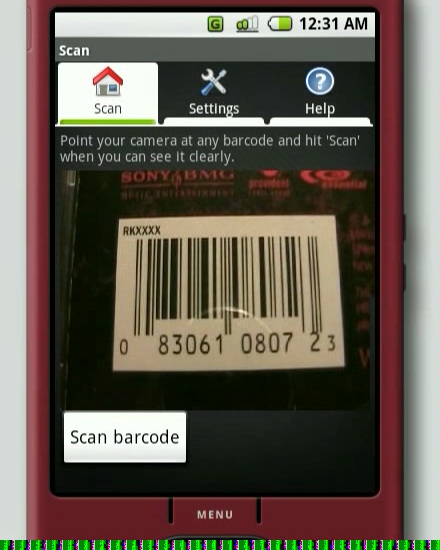
Android Scan

Scan is an Android application that finds pricing and metadata for anything with a barcode. Here are some key features that make Scan stand out:
  • Automatic barcode recognition using onboard phone camera using ZXing
  • Shows CD, DVD, or book cover along with detailed reviews from Amazon.com
  • Searches over a dozen stores, both online and brick+mortar
    • Highlights brick+mortar stores that are nearby, with option to call the store or get directions
    • Links to online storefronts to buy online from the phone
  • Tracklisting for CDs, along with option to play sample tracks right on phone
  • For books, searches local libraries to see if they have a copy
Very Cool. More information and a 3 minute video here.

The idea of using cellphones and bar codes to comparison shop and get additional information about products has been floating around forever, but this is the first time I have actually seen a working demo. The ZXing barcode scanning software is written in Java and is going to be ported to the iPhone, so hopefully applications like this will be available on all sorts of phones. I am particularly interested in seeing this technology leveraged for additional social and environmental information such as carbon footprints.

I haven't been very excited about Google's Android platform for phones, but if this is what the future holds in an Android world, I am all for it. For lots more cool apps that have been designed for Android click the link below.

via TechCrunch

Read More...