Healthy Years of Life

Interesting how Finland and Denmark have similar life expectancies of around 78, but in Denmark just 5 of those are unhealthy (defined as having no limits on activity) while in Finland 15 of them are.
via The Economist
Interesting how Finland and Denmark have similar life expectancies of around 78, but in Denmark just 5 of those are unhealthy (defined as having no limits on activity) while in Finland 15 of them are.
via The Economist
Restoration of a tropical rain forest ecosystem successful on small-scale.
Credit crisis shakes up solar land rush.
Boulder, Colo.: America's first 'Smart Grid City'.
Lease a Mini-E EV for just $850 a month.
A Las Vegas man has filed a libel lawsuit for unfairly being branded a "douchebag".

via TreeHugger
A new study by sociologists at the University of Maryland concludes that unhappy people watch more TV, while people who describe themselves as very happy spend more time reading and socializing. The study appears in the December issue of the journal Social Indicators Research.via Physorg.com
Analyzing 30-years worth of national data from time-use studies and a continuing series of social attitude surveys, the Maryland researchers report that spending time watching television may contribute to viewers' happiness in the moment, with less positive effects in the long run.
According to the study's findings, unhappy people watch an estimated 20 percent more television than very happy people, after taking into account their education, income, age and marital status – as well as other demographic predictors of both viewing and happiness.
Martin likens the short, temporary pleasure of television to addiction: "Addictive activities produce momentary pleasure but long-term misery and regret," he says. "People most vulnerable to addiction tend to be socially or personally disadvantaged. For this kind of person, TV can become a kind of opiate in a way. It's habitual, and tuning in can be an easy way of tuning out."
via Rough TypeAnders Sandberg and Nick Bostrom, of Oxford's Future of Humanity Institute, have published an in-depth roadmap for "whole brain emulation" - in other words, the replication of a fully functional human brain inside a computer. "The basic idea" for whole brain emulation (WBE), they write, "is to take a particular brain, scan its structure in detail, and construct a software model of it that is so faithful to the original that, when run on appropriate hardware, it will behave in essentially the same way as the original brain." It's virtualization, applied to our noggins.
Though "currently only a theoretical technology," WBE is, the authors say, "the logical endpoint of computational neuroscience's attempts to accurately model neurons and brain systems" and "may represent a radical new form of human enhancement." In something of an understatement, they write that "the economic impact of copyable brains could be immense, and could have profound societal consequences."
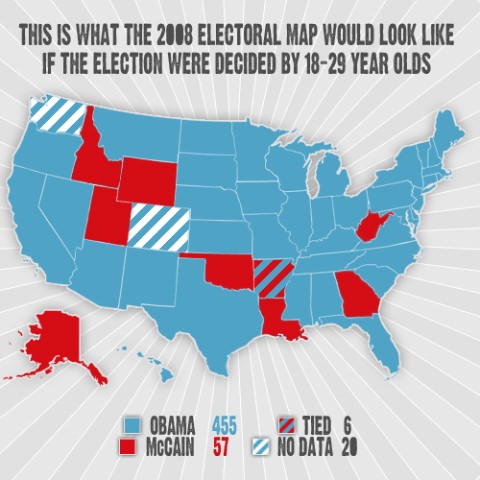
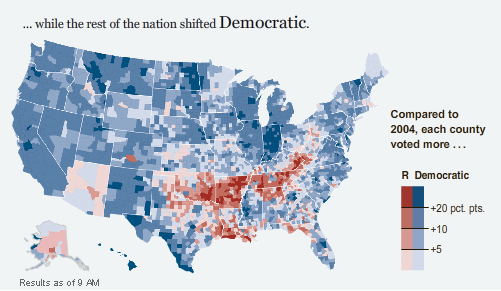
1) How did things change from the 2004 election?
Basically there was just a big shift to the Democratic party throughout the entire US as seen in the map below or this scatterplot.
Kevin Drum lists the demographics that shifted the most since 2004:
Income $200,000 or more (+34), First-time voters (+33), No high school (+27), Latinos (+27), 18-29 year olds (+25), Under $15,000 (+21), Full-time workers (+19), Urban (+19), Non-gun owners (+18), Non-religious (+16), Parents with children under 18 (+16)It isn't clear to me if Bush voters from '04 switched for Obama in '08, or if Obama attracted new voters and many of the Bush voters stayed home. CNN's exit polls have Obama and McCain splitting voters that voted previously, with Obama getting getting his entire margin of victory by winning first time voters 71% to 29%. But, 37% of voters said they voted for Kerry in 2004 vs. 46% that said they voted for Bush. That is very strange as it means that Bush voters were more likely to vote in '08 than Kerry voters. I am skeptical of that.
 Those with incomes over $200,000 voted more for Obama than McCain even though Obama promised to raise the taxes on those making over $250,000 and McCain didn't.
Now: the rest of the genome.
New antireflective coating enables near-perfect absorption of light at all angles in solar panels.
Mini nuclear power plants could power 20,000 homes.
The Census of Marine Life announces incredible deep-sea discoveries.
International con man Barack Obama leaves U.S. with $85 million in campaign fundraising.
A new study details how spammers – the bane of our email inboxes – still make pots of money, despite only receiving a response to one in every 12,500,000 emails they spam out.If there was but a small price tag on sending an email, say 1/10 of one cent, the spam business model would not work and we would be done with it forever.
"After 26 days, and almost 350 million email messages, only 28 sales resulted," says the research paper.
Yet even with this apparently abysmal response rate of less than 0.00001 per cent, the researchers still estimate that the controllers of a network the size of Storm are still bringing in about $7,000 (£4,430) a day or $3.5m (£2.21m) over a year.
A ridiculous update on a ridiculous lawsuit: In August I wrote about a carpooling startup called PickupPal. The idea is that people can gather on the site to find others traveling to the same places, and carpool there to save gas.via TechCrunchGreat idea, right? Wrong. The bus companies freaked and sued under an Ontario law that limits carpoolers to traveling only from home to work and back, riding with the same driver every day and paying only by the week, among other restrictions. This is despite the fact that the government has spent “billions” in carpooling lanes.
Anyway, the court case was decided and PickupPal lost. They were fined CA$11,000 and forced to keep that despicable carpooling activity within the strict limits of the law:
Well we got our ruling from the Ontario Highway Transportation Board (OHTB) and they say that it is illegal to Rideshare in Ontario, (here is the official decision [PDF 0.98 MB]).
The only way you can ride with someone is if you meet ALL of the following extremely impractical set of specific criteria:
* You must travel from home to work only – (Not Home to School, or Home to the Hospital or the Airport)
* You cannot cross municipal boundaries – (Live outside the city and drive in – sorry you cannot share the ride with your neighbour)
* You must ride with the same driver each day – (Want to mix it up go with one person one day and another person another day – no sorry cannot do that – must be same person each day)
* You must pay the driver no more frequently than weekly – (Neighbour drives you to work better not pay her right away just in case she drives you later on in the week)
In order to meet the Renewable Portfolio Standards of states, utilities will need to add an aggregate of nearly 40 gigawatts of clean energy generation by 2030. And to get all that power to customers, a total investment of as much as $2 trillion into transmission and distribution networks will be required, according to a report released today by energy consultancy The Brattle Group.In the report The Brattle Group estimates that transmission and distribution of electricity will require an investment of $880 billion by 2030 compared with either $505 or $951 billion for generation depending on assumptions. Either way, the amount of money spent on building the smart grid is going to be comparable to that building new power plants.
To maintain grid reliability with so much new, intermittent and far-flung renewable energy generation, our national electricity grid needs a serious upgrade. In fact, the Brattle report estimates that more money might have to be invested in the grid than in actual renewable energy generation.
When carbon dioxide comes in contact with the rock, peridotite, the gas is converted into solid minerals such as calcite.I wonder how much this would cost per ton of CO2?
Geologist Peter Kelemen and geochemist Juerg Matter said the naturally occurring process can be supercharged 1 million times to grow underground minerals that can permanently store 2 billion or more of the 30 billion tons of carbon dioxide emitted by human activity every year.
Peridotite is the most common rock found in the Earth's mantle, or the layer directly below the crust. It also appears on the surface, particularly in Oman, which is conveniently close to a region that produces substantial amounts of carbon dioxide in the production of fossil fuels.
They also calculated the costs of mining the rock and bringing it directly to greenhouse gas emitting power plants, but determined it was too expensive.
The scientists, who are both at Columbia University's Lamont-Doherty Earth Observatory in New York, say they have kick-started peridotite's carbon storage process by boring down and injecting it with heated water containing pressurized carbon dioxide. They have a preliminary patent filing for the technique.
They say 4 billion to 5 billion tons a year of the gas could be stored near Oman by using peridotite in parallel with another emerging technique developed by Columbia's Klaus Lackner that uses synthetic "trees" which suck carbon dioxide out of the air.
Peridotite also occurs in the Pacific islands of Papua New Guinea and Caledonia, and along the coast of the Adriatic Sea and in smaller amounts in California.
Morgan Solar is attempting to build a bridge between low cost and high efficiency by concentrating an immense amount of solar energy on to a tiny thumbnail space lined with a superefficient cell from a Cyrium, Emcore or Spectrolab.via The Star and Clean Break
The idea is that such a small fraction of the costly solar cell is needed and so much of the sun's energy is focused on it, that material costs can be kept to a minimum and efficiency can be increased.
It's an approach dubbed "concentrating photovoltaics," or CSP, and a number of companies are in the race, among them U.S. ventures GreenVolts, Energy Innovations, and SolFocus, as well as Ottawa-based Menova Energy.
Morgan Solar has come up with a completely different approach that relies on what it calls a light-guided solar optic. Basically, pieces of acrylic or glass are designed to capture sunlight as it hits a triangular surface less than a centimetre thick. Once inside the material, the sunlight is trapped and corralled through a bottom layer to one corner, where a tiny sliver of solar cell is positioned to absorb the barrage of concentrated light.
The triangles are packaged together to form a square about the size of a Compact Disc case and dozens of these squares make up a single panel.
"It's bloody amazing," says William Masek, president and chief technology officer of Brockville-based Upper Canada Solar Generation Ltd., which has plans to build 50 megawatts of solar farms in Ontario. In the next few weeks he will begin field-testing Morgan Solar's prototypes. "They probably have the most breakthrough solar technology announced in a long time."
Masek says the cost savings for him could be enormous if the technology, as claimed, can affordably convert more of the sun's energy to electricity per square metre than conventional solar panels. "With traditional solar panels we'll need over a thousand acres of property. But if we switch to their system, we can cut that land requirement in half and also substantially cut our costs," he says.
The materials that make up the panels are nothing fancy or expensive, Nicolas Morgan says during an interview at the company's office. The solar panels are flatter than the competition, lighter, cheaper to build and can concentrate the light at up to 1,500. "This is completely new. Nobody has done it this way," he says.

If you are like me, you open up a ton of interesting articles in different tabs and then struggle to read them all. Read It Later allows you to easily bookmark these articles by clicking a checkbox in the address field. All of the articles are stored in one location and can be accessed easily later. Once you have read an article you can uncheck it and remove it from the list. The newly released .99 version adds Google Reader integration which makes it even better.
You can check out a demo of it in action.
Lifehacker had a good review of the add-on and also awarded it best update to an add-on for Firefox 3. You can install it from Mozilla's Add-on site.
Less than a year after announcing its deal with Merrill Lynch, Raser Technologies is set to open its first low-temp geothermal plant tomorrow in Utah. While it remains to be seen what happens when the switch is flipped, the company has so far made good on its promise to build geothermal plants in record time — it typically takes up to five years, and Raser has done it in less than one.I wonder how expensive the electricity produced will cost? If economic, this is a great way to provide clean baseload electricity.
The 10-megawatt plant pulls together 50 small units to tap into a small sliver of 120,000 megawatts of low- and medium-temperature geothermal resources cataloged by the National Renewable Energy Laboratory and U.S. Geological Survey. Raser claims accessing low- and medium-temp geothermal power could eventually help meet about a third of U.S. energy needs.
Of course, this is all provided that the company’s technology — which mixes geothermal resources with a “working fluid” that boils at a much lower point than water to make commercial grade power from temperatures as low as 165 degrees Fahrenheit — and its modular power plant design work as well at a commercial scale as they have in pilot projects.




 RSS Feed