Tuesday, October 31, 2006

63 Terawatts of Phytoplankton Chemical Power

Oceanographers worldwide pay close attention to phytoplankton and with good reason. The microscopic plants that form the vast foundation of the marine food chain generate a staggering amount of power, and now a groundbreaking study led by Florida State University has calculated just how much –– about five times the annual total power consumption of the human world.

Physical and biological oceanographers led by FSU Professor William Dewar put the yearly amount of chemical power stored by phytoplankton in the form of new organic matter at roughly 63 terawatts, and that's a lot of juice: Just one terawatt equals a trillion watts. In 2001, humans collectively consumed a comparatively measly 13.5 terawatts.
via Underwater Times

Read More...

Monday, October 30, 2006

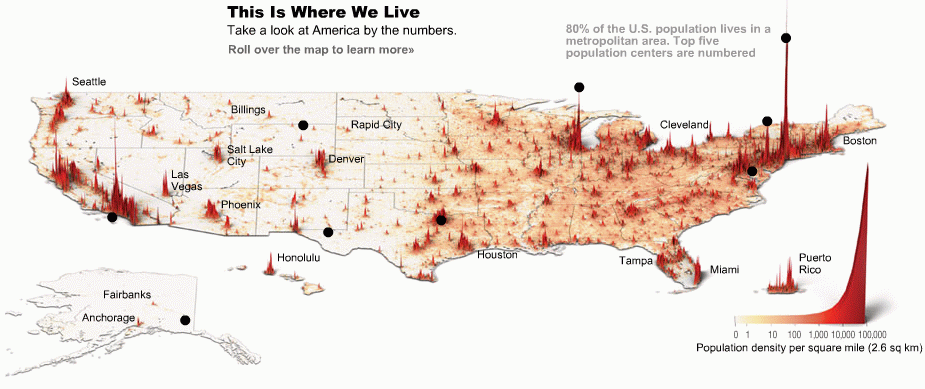
Cool Visualization of US Population Density

Click on the image for a larger version, or better yet check out the Flash version over at Time.com.

via Digg

Read More...

Boy Reportedly Takes Stolen Bus On Route

A 15-year-old boy stole a bus, drove it along a public transit route, picked up passengers and collected fares, authorities said Sunday.

"I drove that bus better than most of the LYNX drivers could," the teen, who is too young to drive legally, told a deputy after he was stopped and arrested. "There isn't a scratch on it. I know how to start it, drive it, lower it, raise it."

Davis had previously been charged for a similar bus theft. Details of that case were unavailable Sunday.

Passengers and deputies noted Davis drove the bus at normal speeds and made all the appropriate stops on the route. One passenger, suspicious of the youthful looks of the driver, called 911.
Now while the media will probably try and blame Grand Theft Auto for putting ideas like this in the head of the kid, we all know that the blame lies squarely with Seinfeld:
GEORGE: You ran?

KRAMER: No, I jumped on the bus. I told the driver, "I got a toe here, buddy, step on it!"

GEORGE: Holy cow!

KRAMER: Yeah, yeah. Then, all of a sudden, this guy pulls out a gun. Well, I knew any delay is gonna cost her her pinky toe, so I got out of the seat, and I started walking towards him. He says, "Where do you think you're going, Cracker Jack?" I says, "Well, I got a little prize for ya, buddy." [Makes punching moves.] Plow! Plat! Ke-yah! Knocked him out cold.

GEORGE: How could you do that?!

KRAMER: Then, everybody is screaming, because the driver, he's passed out because of all the commotion. The bus is OUT of control. So I grab him by the collar, I take him out of the seat, I get behind the wheel. Now I'm driving the bus.

GEORGE: You're Batman.

KRAMER: Yeah, yeah, I am Batman. Then the mugger, he comes to, and he starts choking me. So I'm fighting him off with one hand and I kept driving the bus with the other. Then, I managed to open up the door, and I kicked him out the door, you know, with my foot, you know, at the next stop.

JERRY: You kept making all the stops?!

KRAMER: Well, people kept ringing the bell!
via WFRV via Digg

Read More...

Philips Flexible Electronic Ink Display


Can't wait to get my hands on one of these.

I was all pumped up about the Sony Ebook Reader, but then I got my hands on one and was disappointed by it. The screen is too small to view 8.5x11" .pdfs, there is no search function, there is no way to highlight/take notes, and the bookmark feature is kind of weak. There was talk of it being good for storing technical manuals for easy reference without all the heft. Forget about it. Without a search feature that won't work. Really the only thing it is good for is for reading novels.

The iLiad is a bit more promising with a larger screen that has a touch screen that you can write on and take notes. But at 650 EUR it is pricey and the software looks really rough.

So what I am now hoping for is a rollable ebook that could roll out to be 8.5x11" and completely display a .pdf page (or maybe 8.5x5.5" and show 1/2 at a time).

via An Unreasonable Man

Read More...

Sunday, October 29, 2006

Improve Health Rather Than Health Care

Dr. William H. Foege makes the case that we should be focusing on improving health rather than improving health care.

American health care might also take a lesson from the World Bank, which pioneered a tool in 1993 to measure the state of health in populations. Called "Disability Adjusted Life Years," or "DALYs," this metric incorporates rates of suffering and death into a single number, making it possible to see and compare the impact of various health problems and interventions among populations.

For example, this tool can provide analysts with a snapshot of the total disease burden of an area and the contribution of various factors, such as cancer, infections, and so on. Because it allows comparisons, it has been used by organizations such as the World Health Organization to set priorities for investment in health improvements.

DALYs still lack important ingredients such as measures of quality of care or feelings of well-being. Health is more than the absence of disease. Also, the DALYs metric doesn't reflect the relative values that various societies place on different kinds of suffering or the relative values they assign to life at different ages. Still, experience with the DALYs tells us that it's possible for economists to develop a metric called Disability Adjusted Health Outcomes as a way to measure and compare the effectiveness of the care we pay for.

With such a tool in hand, health plans could be reimbursed based on their ability to achieve those outcomes. The marketplace would then shift focus from process measures to improvement of health. Comparing how various health plans stack up in terms of millions of "person-years" of health experience would quickly reveal which plans are doing best. Thus, the marketplace would be harnessed to improve health profiles nationwide.
I like this concept. Focus on improvements in DALYs rather than treatments or access to care (although these would be dealt with indirectly) and then allow the market to determine the most efficient ways of doing this.
Health plans could be reimbursed with bonuses for the improvement of conditions that are lowering population-wide health measures. This would cause health plans to enroll sick people and provide smoke-enders programs, exercise and diet programs, as well as superb diabetes-control programs.

Imagine competing to enroll the disenfranchised, with current Med-icaid funds subsidizing their premiums! Suddenly, the marketplace would incorporate prevention into medical practice. Imagine if the marketplace succeeded where current medical care failed!
That is also an interesting concept. Have the health providers compete over the disenfranchised because they are where you could improve DALYs for the least amount of money.
The major argument against such a plan is that we can't agree on defining or measuring health outcomes. If that is actually true, it means we are in a business where we don't know how to define success.
Unfortunately, I think that is correct. Measuring DALYs and health outcomes is a very tricky business. But, I think a health care system based on these principles would do a better job at providing the right incentives than the one we have now.

via The Seattle Times

Read More...

The Brain Business

As nations are transitioning from industrial to knowledge based economies, the economic statistics have not kept up. Here is one attempt in Europe to measure who is doing best at fostering and using knowledge and skills.

Until now, though, it has been frustratingly hard to measure who is fostering knowledge best. Instead, there have been partial indicators, such as who spends what on research and development. Or there have been indicators of something slightly different, such as competitiveness rankings compiled by the World Economic Forum, the organisers of annual conferences in Davos.

Hence the value of a brave stab at measuring knowledge and skills, broadly defined. It comes from two European think-tanks, the Lisbon Council in Brussels and the Frankfurt-based Deutschland Denken (Think Germany), and has been devised by Peer Ederer of the Zeppelin University in Friedrichshafen.

Mr Ederer's scorecard has four columns. First comes a country's knowledge base or, as economists call it, “human-capital endowment”. This is the imputed value of all the effort that has gone into educating and training everyone in the country. Formal study is part of it, but so is the value of time spent parenting. Results here vary surprisingly widely between countries, with Sweden doing brilliantly and Italy poorly.

This column also includes adult education and in-house training by companies. In turns out that these have at least as big an impact on a country's ability to create knowledge as the relative performance of its education system does. The resulting score for human-capital endowment is then depreciated, for what is called, with delightfully euphemistic tact, “obsolescence in the knowledge base and some level of forgetting”.

Next comes employment. It is no good training people and giving them splendid skills if they don't have a job, so the second measure is “human-capital utilisation”. That is a bit like a traditional employment rate but weighted for education, training and the rest of it. And as it is not much use training people and giving them jobs if they are working inefficiently, the study therefore includes a third measure, of productivity, to capture how well a country is using knowledge. It divides economic output by the human-capital stock (normal productivity measures, in contrast, divide output by the number of hours worked). Lastly, Mr Ederer included demographic change, since even if a country has well-trained people, with good jobs, working effectively, its knowledge base will still decline if low fertility means its working-age population is shrinking.
I think that sounds pretty good and wouldn't mind someone doing a similar study by state in the US.

And who are the winners in Europe?
Putting that lot together, you come up with an overall score. European countries divide into three groups: A-grade students (with Sweden easily the best, followed by Denmark, Britain, Austria and the Netherlands); muddlers in the middle (Finland, Ireland, France and Belgium); and lastly duffers who ought to be held back a year (Spain, Portugal and—oddly—Germany, with Italy trailing way behind).
And how does this compare with just looking at standard economic measurements?
In some ways, these grades might not look all that surprising. They are similar to what you would get if you looked at countries' general economic management over recent years: the Nordics (including Britain and Austria as honorary members) are doing well; Mediterranean and large continental economies are in trouble.
And there is the rub. While the current economic statistics might not capture the information that seems most relevant, they still end up being a good proxy and give similar results.

via The Economist

Read More...

Friday, October 27, 2006

Six Tips for Happiness

Advice from Tal Ben-Shahar, the lecturer who teaches Harvard's course on Positive Psychology.

1. Give yourself permission to be human. When we accept emotions -- such as fear, sadness, or anxiety -- as natural, we are more likely to overcome them. Rejecting our emotions, positive or negative, leads to frustration and unhappiness.

2. Happiness lies at the intersection between pleasure and meaning. Whether at work or at home, the goal is to engage in activities that are both personally significant and enjoyable. When this is not feasible, make sure you have happiness boosters, moments throughout the week that provide you with both pleasure and meaning.

3. Keep in mind that happiness is mostly dependent on our state of mind, not on our status or the state of our bank account. Barring extreme circumstances, our level of well being is determined by what we choose to focus on (the full or the empty part of the glass) and by our interpretation of external events. For example, do we view failure as catastrophic, or do we see it as a learning opportunity?

4. Simplify! We are, generally, too busy, trying to squeeze in more and more activities into less and less time. Quantity influences quality, and we compromise on our happiness by trying to do too much.

5. Remember the mind-body connection. What we do -- or don't do -- with our bodies influences our mind. Regular exercise, adequate sleep, and healthy eating habits lead to both physical and mental health.

6. Express gratitude, whenever possible. We too often take our lives for granted. Learn to appreciate and savor the wonderful things in life, from people to food, from nature to a smile.

via Boston Globe (.pdf) via Quote-A-Day

Read More...

A Native Inuit Mourns a Lost Way of Life

Taptuna is -- in his bones and his history -- a hunter and trapper. It is what he loves, he says. But the world he grew up in, a world of winter igloos and summer fishing camps and working the traplines, is changing. Now, like so many other native Inuit, he is confined, and sits in an office watching an ancient way of life slip away.
It is always sad when people are losing the way they have been living for thousands of years. As he explains:
"There's no future living off the land. Those days are gone," he says. He figures it costs an average of about $60,000 to equip a hunter to go out. Add preciously priced fuel for the skimobile or boat motor. The meager snow cover on the land is playing havoc with snowmobiles. "You're hitting rock, and you're doing big-time damage."
Wait, did he just say skimobiles, boat motors, and $60,000 worth of gear? WTF? I don't remember those as being part of the Inuit's ancient way of life.

But, at least they are still living in the igloos, right?
Outside, the hamlet of 1,400 sprawls across the rounded landscape in a jumble of angular houses, scattered on the land like a child's jacks. Inside those modern buildings, the sons and granddaughters of Inuit who lived in snow houses and kept warm in wolf fur and sealskin now sit in shirt sleeves by their furnaces. They are watching satellite television instead of hunting.
Doh, that basically sounds like Anytown, USA.

I remember watching a show on TV talking about how the Inuit were losing their ancient way of life due to global warming and increased pesticide concentrations in marine mammal fat. I expected to see tribes living in log cabins or igloos that would then go out in their kayaks and hunt with spears for seals or walruses. Or maybe they would hunt polar bears being transported by a dog sled. Instead I saw people hunting for seals using an aluminum power boat and shooting them with rifles.

Maybe it is just me, but I think their ancient way of living is already gone.

via The Washington Post

Read More...

Living Planet Index 2006

Previously, I called for a species census to measure the population of all species so we can see man's impact on the globe. Rather than just worrying about species that are going extinct, we could see if previously large populations of animals were dwindling and stabilize their populations before they get close to extinction.

Fat Knowledge threw down the gauntlet and the WWF responded. They just released the Living Planet Report for 2006. In it is the Living Planet Index which is determined as follows:

The Living Planet Index measures trends in the Earth’s biological diversity. It tracks populations of 1 313 vertebrate species – fish, amphibians, reptiles, birds, mammals – from all around the world. Separate indices are produced for terrestrial, marine, and freshwater species, and the three trends are then averaged to create an aggregated index. Although vertebrates represent only a fraction of known species, it is assumed that trends in their populations are typical of biodiversity overall. By tracking wild species, the Living Planet Index is also monitoring the health of ecosystems.

The Living Planet Index is a measure of the state of the world’s biodiversity based on trends from 1970 to 2003 in over 3 600 populations of more than 1 300 vertebrate species from around the world.
That sounds pretty good and is the kind of report I was looking for. Of course I wonder how representative of all species it is as there are approximately 1.8 million known species, and another 13 million or more that have yet to be discovered.
No attempt is made to select species on the basis of geography, ecology, or taxonomy, so the index dataset contains more population trends from well researched groups, especially birds, and well-studied regions, particularly Europe and North America.
Sounds like it might not be completely representative.

Another issue is that they appear to exclude all domesticated animals such as cattle, goats, pigs and chickens. I can understand that if you were calculating a Wildlife Planet Index, but this is the Living Planet Index. If you are trying to calculate the total amount of life on the planet (see my Pro Life Agenda and Net Primary Productivity) I don't see why you wouldn't count them as well.

Also because they track the same species year after year from 1970, it doesn't count "invasive" species and actually counts them as a negative when they replace native species. I prefer to call them "immigrant" species (of which the greatest immigrant species is a primate that originated in eastern Africa and has now spread across the globe) and they also should be counted in the total amount of life on the planet.

Alright, there are some potential issues, but what conclusions did they draw?
Between 1970 and 2003, the index fell by about 30 percent.
That doesn't sound very good. What happens when you break it down by region?

Tropical species populations declined by around 55 per cent on average from 1970 to 2003, while temperate species populations, which would have shown marked declines prior to 1970, have shown little overall change since.
All of the species loss has occurred in the tropical region. The temperate species population has stabilized (which is not surprising since forests are increasing in most of the temperate countries).

A similar situation can be seen in the oceans as the population of species in the Pacific Ocean are stable and the Atlantic/Arctic region has shown a slight increase. Meanwhile populations are down 30% in the Southern Ocean and more than 50% in the Indian/Southeast Asian Ocean.

From these results, attention on species population needs to be focused on South America, Africa and Asia (although demand for timber and cattle from Europe, America and China might be part of the underlying problem).

In the future, I would like to see more species be censused (with a priority on the tropical species), including domesticated and immigrant species. This would truly make it a Living Planet Index and would still allow for people to look at the impact of just wild species if they choose. In would allow us to understand if in the tropical regions they are replacing wild species populations with domesticated ones, or is life just being lost.

While this report is a good step, I have other unanswered questions that hopefully will be addressed in future versions:

What would it take to stabilize species populations?
What is the impact of human population growth on these species populations?
What is the impact of one additional person living in a tropical or temperate region?
If an additional person has a smaller impact in temperate than tropical region would greater immigration from tropical regions to America and Europe lead to lower worldwide species population loss?
What is the impact of additional natural resource use by people?
Which natural resource use reduction would lead to the greatest increase in wildlife?
Can you quantify the trade off between additional human population, greater natural resource use and wild species populations?

Read More...

Model for Sustainable Development: Cuba?

The WWF just released their Living Planet Report for 2006 (.pdf). As part of it they rank countries on sustainable development based on their Ecological Footprints and their Human Development Index (HDI) (.pdf) score. HDI is a ranking developed by the UN that ranks country by life expectancy, literacy and GDP. Ecological Footprint looks at how much land is needed to support each person's food, timber, clothing and energy needs. The higher their HDI score and the lower their footprint the more sustainable the development. You can click on the image on the left for a larger version of the rankings.

The goal of countries over time should be to increase their HDI ranking while decreasing their footprint, or moving down and to the right on the graph. Almost all countries are moving up and to the right, but India and China are moving much more flatly (more slowly increasing their footprint) than the US, Korea or Italy.

All countries except one either have too large a footprint or too low an HDI score to be considered sustainable development. Now I am not going to accuse the WWF of being communists, but that one country that meets their minimum criteria for sustainability is Cuba. The WWF doesn't really hold Cuba up as a role model, qualifying with statements like "Cuba alone did, based on data it reported to the UN" and saying "freshwater scarcity and civic engagement should be included in sustainable development".

Should Cuba be praised for their model of development? I don't really know enough about Cuba to be a judge of this. I remember reading Michener's Caribbean and being surprised that people many people living in Cuba saw their way of life to be superior to that of America's (of course the Cuban immigrants in Miami felt the exact opposite). Their education system leads to a 96.9% literacy rate and their life expectancy of 77.41 is almost the same as that of the US at 77.85. I have read articles praising and criticizing Cuba's health care system. National Geographic praised Cuba for their environmental protections. On the other hand the Washington Post wrote about how most people have to buy things "on the left" to get around the chronic shortages and government laws. And of course there is the lack of political freedom.

Part of the problem could be that like the Happy Planet Index, while the intentions of this metric are good, the way it is calculated is suspect. I have written before about how the Ecological Footprint methodology penalizes countries with high ecological productivity like Canada, New Zealand, Sweden and Norway. While these countries are all net ecological creditor nations, they all show up as having large footprints.

In general these reports tend to play down increases due to improved productivity of the land. According to their numbers the total biocapacity of the planet has increased from 9.0 to 11.2 billion global hectares from 1961 to 2005 an increase of 24%. The average hectare of land has increased in productivity 16% since 1961. While decreasing consumption is one way to get to a sustainable level, increased productivity is another and one that is more palatable to everyone.

I have also written how I don't think energy use should be included in the Ecological Footprint. While switching to renewable and pollution free energy is important to sustainable development, translating energy use into acres of land doesn't make much sense to me. And treating nuclear energy like fossil fuels also makes no sense to me. The WWF appears to understand my concerns as they have broken nuclear energy out as a separate component this year. If you don't think it belongs in the footprint, now you can easily adjust the calculations.

If you make adjustments on how productivity is handled in the footprint and how energy use shows up, I bet a lot more countries would be in the sustainable development club. While I like the idea of coming up with a metric for sustainable development, this current version needs a little retooling before it becomes an accurate reflection of where countries are.

Read More...

Bio-Shirt Monitors Athletes

Bio-Shirts, developed by Korea's state-backed Electronics and Telecommunications Research Institute, were introduced last week at the National Sports Festival. The shirts are designed to monitor various physiological parameters so elite athletes don't push themselves too hard. Several sprinters tried out the Bio-Shirts.

The Bio-Shirt has two parts; a specially designed lightweight shirt and a monitoring system that weighs just 20 grams including the battery. The battery life will be prolonged to cover the average running time of amateur marathon runners—about five hours.

"Next year, people wearing Bio-Shirt will be able to know their temperatures, heart rates and speeds while running on a real-time basis using a wristwatch-type miniature computer enabled by Bluetooth," said development team leader Kim Seung-hwan.

"When any of the three data types hits a ceiling configured in advance, a warning sign will let marathoners know it is time to stop running and take a rest," Kim said.

The shirt can also be used as a non-invasive ambulatory monitoring system for medical patients.
via LiveScience

Read More...

Thursday, October 26, 2006

Happiness, Welfare, and Economic Growth

Does money buy happiness? The rapidly expanding literature on what determines “subjective well-being” appears to suggest a negative answer to this timeless question. Studies consistently find, for example, that when the incomes of everyone in a community grow over time, conventional measures of well-being show little change.

Many critics of economic growth interpret this finding to imply that continued economic growth should no longer be a policy goal in developed countries. They argue that if money buys happiness, it is relative, not absolute, income that matters. As incomes grow, people quickly adapt to their new circumstances, showing no enduring gains in measured happiness. Growth makes the poor happier in low-income countries, critics concede, but not in developed countries, where those at the bottom continue to experience relative deprivation.

All true. But these statements do not imply that economic growth no longer matters in wealthy countries. The reason, in a nutshell, is that happiness and welfare, though related, are very different things. Growth enables us to expand medical research and other activities that clearly enhance human welfare but have little effect on measured happiness levels.

Critics of economic growth cite its threat to the planet’s survival. Yet it is not growth per se that threatens, but rather certain kinds of growth. Driving more S.U.V.’s causes harm, but taking more piano lessons does not. Any country with a government not beholden to corporate interests could easily curb environmentally harmful activities through taxation and regulation, redirecting spending toward things that really matter. Across developed countries, higher growth rates are actually associated with cleaner environments, not dirtier ones. The United States is the world’s largest emitter of greenhouse gases not because of its wealth but in spite of it.
Good stuff. The article goes into some example of how welfare and happiness are different. A worthy read.

via NYTimes

Read More...

Revolt of the Fairly Rich

"I've seen it in my research," says pollster Doug Schoen, who counsels Michael Bloomberg and Hillary Clinton, among others. "If you look at the lower part of the upper class or the upper part of the upper middle class, there's a great deal of frustration. These are people who assumed that their hard work and conventional 'success' would leave them with no worries. It's the type of rumbling that could lead to political volatility."

Lower uppers are professionals who by dint of schooling, hard work and luck are living better than 99 percent of the humans who have ever walked the planet. They're also people who can't help but notice how many folks with credentials like theirs are living in Gatsby-esque splendor they'll never enjoy.

You can hear the fallout in conversations across the country. A New York-based market research guru - a well-to-do fellow who's built and sold his own firm - explodes in a rant about ultras bidding up real estate prices. A family doctor in Los Angeles with two kids shakes his head that between tuition and donations, ultras have raised the ante for private school slots to the point where he can't get his kids enrolled. A senior executive at a nationally known firm seethes at the idea of eliminating the estate tax; it is an ultra conspiracy, in his view, a reprehensible giveaway to people whose outsized lucre bears little relation to hard work.
Today's example that wealth is always relative.

via Fortune

Read More...

Beta Baby, Beta!

As you have probably noticed, this blog has a new look and feel. I bit the bullet and upgraded to Blogger Beta.

Some new features that I hope you will like:
Labels - Posts will now have labels so you can browse them by categories such as Energy or Funny posts. Unfortunately, there is no easy way to properly label old posts without going through them manually. So, it will take me a bit of time to get all the old posts labeled and make the category listings really valuable.

Wider Page
- The new template I used is a "stretched" version, so you can read more on each page without having to scroll down.

Older Posts
- When you get to the end of a page, you can now click on "older posts" and get the 15 previous posts.

Expandable Posts
- On long posts, the main body of the text is hidden so you can easily scroll past it if you don't want to read it. When you click on the "Read More..." link, the rest of the text will show up and now this will happen on the same page (as opposed to my earlier version that took you to a new page). When you are done reading, you can collapse it by clicking "Summary Only..." at the bottom. Thanks to Hackosphere and Beautiful Beta for their work on this. There is currently a bug where if you click on the older posts link, all posts have the "Read More..." option rather than just the ones with expandable content. Hopefully this will be fixed soon.

Blog Archive
- The blog archive is now a tree version where you can see posts for each month.

Digg and Del.icio.us links - Now you can save a post directly to your del.icio.us account or submit a post to digg. Thanks to Vivek Sanghi for work on this one.

Email Post to a Friend
- If you click on the envelope icon you can email the post to a friend.

RSS Feed for Post Comments - If you want to see if there are any responses to your comment, now you can subscribe to a feed on a per post basis.

This new beta version also appears more stable. After I converted, regular Blogger sites went down for an hour or so, but the beta versions were still accessible. Hopefully the new version will have less outages then the current one.

The new version is database driven and dynamically renders pages. There is no longer a need to republish an entire site when you change a layout. Probably doesn't mean much to readers, but to those of us that use Blogger this is a very nice addition.

For more reviews on Blogger Beta check A Consuming Experience, TechCrunch, or BlogHacker.

Hopefully you will like the changes. If you have any suggestions or thoughts on the changes, please leave a comment.

Read More...

Wednesday, October 25, 2006

Interesting Articles of the Week

Baboon "Gangs" in South Africa break into houses, emptying fridges, ruining furniture, and defecating all over.

Who votes, who doesn't, and why.

Economics class taught completely as a video game.

Omega-3, junk food and the link between violence and what we eat.

A person's face will always reveal his true feelings--if, like Paul Ekman, you are quick enough to recognize microexpressions.

Inmate commits suicide hours before execution.

Read More...