Showing posts with label Labeling. Show all posts

Tuesday, July 07, 2009

On Web and iPhone, a Tool to Aid Careful Shopping

These days, every skin lotion and dish detergent on store shelves gloats about how green it is. How do shoppers know which are good for them and good for the earth?

Hence GoodGuide, a Web site and iPhone application that lets consumers dig past the package’s marketing spiel by entering a product’s name and discovering its health, environmental and social impacts.

“What we’re trying to do is flip the whole marketing world on its head,” said Mr. O’Rourke. “Instead of companies telling you what to believe, customers are making the statements to the marketers about what they care about.”

The next version of the iPhone will enable people to scan bar codes to get scores, rather than type in the product’s name.
I wrote about GoodGuide before and I think giving social and environmental information to people at the point of purchase (ideally by mobile phone via bar scanner) is a great idea. I have been writing about this concept since way back in April of 06 and all the posts with a Labeling label are about this concept.
Although the GoodGuide Web site, which started in September, had only 110,000 unique visitors in April, Mr. O’Rourke is encouraged that it is growing about 25 percent a month. Lately, interest in GoodGuide has begun to extend beyond techies and the Whole Foods crowd to the Wal-Mart crowd, as Mr. O’Rourke put it. One sign of that broader appeal: Apple recently featured the app in its iPhone ads.

GoodGuide’s office, in San Francisco, has 12 full-time and 12 part-time employees, half scientists and half engineers. They have scored 75,000 products with data from nearly 200 sources, including government databases, studies by nonprofits and academics, and the research by scientists on the GoodGuide staff. There are still holes in the data that GoodGuide seeks to fill.

Some companies, including Clorox and SC Johnson, have agreed in recent months to reveal more about the ingredients in their products because of gathering consumer concern. That will enable GoodGuide to fill gaps in its data. Federal law does not require makers of household products to list all ingredients.

This summer, GoodGuide will add a deeper database for users who want more detail by, for example, reading the academic studies on which ratings may be based.
It is going to take a while to catch on, and only a fraction of the population will ever use such an application, but even that will be enough to get manufacturers concerned about it and work toward higher ratings.

The more data that companies make available the better the accuracy of the ratings will be. And more detail on how scores were set would be greatly appreciated by those of us that really want to dig in and understand what the scores mean.

The article talks about how their business model is still evolving but it is run for profit and currently gets its money by linking to Amazon and in the future by charging companies like Whole Foods that want to put the ratings in their store. I am curious if maybe a non-profit model might work better here with funding from philanthropists, and much of the work done by volunteers. Or maybe a Consumer Reports model where end users pay for a subscription.

via NY Times

Read More...

Sunday, December 28, 2008

Oregon Governor Seeks Mandatory Efficiency Audits for Home Sales

Oregon’s governor, Ted Kulongoski, wants to require any owner selling or renting a home or commercial building in the state to obtain a certificate disclosing the property’s energy use and greenhouse gas emissions. The mandate, part of his climate change agenda for 2009, would take effect in 2011 for new and existing homes and in 2012 for commercial buildings.

The certificates could prove both a selling point for owners of energy-efficient buildings and a boon to homebuyers by providing a basis for lower mortgage and insurance rates tied to efficiency.

The basis for such a system might well come from Earth Advantage, a nonprofit sustainable building organization based in Portland. That group has already developed a national certification program for new construction, and it has been working on an efficiency rating program modeled after one in Britain, which began requiring certificates for all residential real estate transactions nationwide on Oct. 1.
I think this is a really good idea. It is just like auto fuel-efficiency stickers on cars.

In many cases greater energy-efficiency in homes offers a higher rate of return than the mortgage rate, and would therefore lower monthly payments, but buyers are unaware of how much it costs to heat the home. This labeling would give consumers that knowledge and would both help the environment and save them money.

Some might wonder why this needs to be mandated. Won't consumers naturally do this on their own if it is in their own best interest? But, consumers haven't been doing this, so it makes sense for the government to come in and mandate the audit.

via Green Inc

Read More...

Saturday, November 22, 2008

Label Wars

Over at Reason they took a look at the issues with using Food Miles as a way to determine the carbon footprint or the environmental impact of the food you are eating.

I found this passage particularly amusing:

Nevertheless, organic food activists in Britain's Soil Association argued for lifting the organic certification from Kenyan food exports because they are brought into Britain on airplanes. Some high-end British retailers have begun slapping a label featuring an airplane on various food products to indicate that they have been air freighted. Kenyan growers cannily responded by launching their own "Grown Under the Sun" label, pointing out that their agricultural production methods emit far less greenhouse gases than many crops grown in Britain do.
Personally, I would go with the Kenyan growers.

Read More...

Thursday, October 16, 2008

Carbon Footprint of a MacBook

I have called for carbon labeling on all products and Apple has taken up the challenge. With their new MacBooks, they have released an environmental report (thanks to Earth2Tech for the pointer) that specifies how much CO2 is emitted in the production and use of the laptops.

Over the 4 year lifespan of a MacBook, it is responsible for 460 kg of CO2 emissions (115 kg per year). At 8.8 kg of CO2 per gallon of gasoline, that is equivalent to the emissions of 52 gallons (13 gallons a year). 115 kg is just .6% of the average American's 20,000 kg of co2 emissions a year.


As the chart shows, 50% of the life cycle emissions of a MacBook come from the production and manufacturing of the device (230 kg). Unfortunately there is no additional information as to what the main contributors to this value were.

Another 10% (46 kg) of the emissions come from the transportation of the laptop. That is the equivalent of 5 gallons of gasoline, which seems like a lot for a 10 lb device. I looked at one carbon offset program for shipping that assumed .08 lbs of co2 per ton mile shipped. At 1/200 a ton, this would mean that the laptop was shipped 253,000 miles or 32 times around the Earth. How far are they shipping these laptops?

39% (180 kg) of the emissions come from producing the electricity needed to run the laptop for 4 years (45 kg per year). Not clear what kind of assumptions they made for how many hours a day the laptop was operating or what the source of the electricity was.

One of the easiest ways for a consumer to reduce their carbon footprint is to wait longer before upgrading their computer. Using a MacBook for an extra year would bring the 5 year emission total to 510 kg (an addition of 45 kg), lowering the annual amount to 102 kg, a savings of 13 kg a year.

The yearly emissions of a MacBook are fairly similar to that of mobile phone based on this study that I looked at. The production of a mobile emitted 60 kg of CO2 and the usage another 52 kg for a total of 112 kg of CO2 a year (the study assumed that the phone is replaced after a year). That is almost identical to the 115 kg a year that using a MacBook generates.

The MacBook's co2 emissions equivalent to 52 gasoline gallons is a bit less than the 64 gasoline gallons of energy equivalent that a computer and monitor used over their lifetime based on this study I previously looked at (50 gallons for the manufacturing of the computer and 14 for the usage over 4 years). They aren't completely comparable as the other study just gives energy usage and not CO2 emissions.

I hope more computer manufacturers follow Apple's lead and publish the carbon footprint of the machines they manufacture.

Read More...

Wednesday, October 08, 2008

Baacode

Baacode is the very clever moniker that outdoor sports apparel company, Icebreaker, have given their superfine merino garment traceability program. Much touted over the past few months, Baacode was officially launched this week. For as of this month new garments will sport a barcode number on their labelling. Customers can type this code into a website search engine and it will take them on a tour of the New Zealand high country sheep station (ranch) where the merino wool came from.


As Icebreaker put it in their media release: “Customers will see the living conditions of the sheep, meet the high country farmers who run the sheep stations, and follow the production process that turns premium merino fibre into Icebreaker's exceptional, performance-driven garments.” Icebreaker founder and CEO says, "For us, sustainability is about transparency and being able to show the whole design for the business, which starts with the growers and continues through every step of the supply chain."
I am always on the lookout for ways to better understand the backstory of my purchases and the social and environmental impacts of producing them. The Baacode is helpful in that regard. While the FAQ states that you can "meet the farmers and the living conditions of the sheep, then follow the fibre to the factories that knit, dye, finish, cut, manufacture and ship the garments", the demo that they provide only allows you to meet the farmers. Cool none the less.

via TreeHugger

Read More...

Friday, October 03, 2008

GoodGuide

From Earth2Tech:

GoodGuide rates products based on data that falls into three categories: social, environmental (including carbon footprint) and health. Each rating is based on more than 140 pieces of such information, such as whether or not a product has been tested on animals, what its ingredients are — even whether or not its parent company has women or minorities on its board. The data itself comes from hundreds of private and public sources, among them government, non-profits and private, third-party research firms.

He even envisions consumers checking out the site on their mobile phones as they browse the shopping center aisles. In three weeks GoodGuide plans to launch an iPhone app, and they already have a text messaging application that will SMS you the rating.
I have been looking for a way to compare products on social and environmental attributes based on standard data, and this is the best website I have seen so far. I really like the idea of an iPhone app to allow you to compare products while at the store.

GoodGuide gives each product a 1-10 rankings on health, environment and social performance. Each category is then broken down into specific rated attributes such as labor & human rights for social performance. You can take a look at Tom's Of Maine Natural Baby Shampoo for an example of how it works.

I like how it is data driven and you can see the source of where each score came from. I would actually like the ability to drill down even deeper and see more information on the sources such as scoring criteria, assumptions made and data collection techniques.

I also like this:
In the future, GoodGuide will have tools to let consumers screen this data through their own personal preferences, allowing them to "filter" and search for products and companies that match their specific values.
I could see environmental organizations and churches setting up different scoring systems based on their values. I would also like to be able to create my own filter based on what I value.

One thing I don't like about the current rating system is that it doesn't tell you how large the impacts are of your decisions. I mean is there really much of an environmental impact from purchasing dental floss and will changing to another brand really make much of a difference? It is not clear which products have the largest impact and are the most important to focus on.

The initial product categories are very limited with just personal care and household chemicals. The number of products under each category is also limited. While I understand that they have to start somewhere, there aren't really enough products to make this service very useful. Hopefully they will be adding new products and categories quickly. I hope they add personal electronics soon.

It would also be helpful if you could do head to head comparisons between two products. You could bring up the product you are currently using and then see what the impact would be of switching to a different product.

Another way to make this information more accessible would be to create a browser plugin (similar to this idea) that displays this information when I am browsing products at Amazon, and could also suggest a few replacement products that have better social and environmental records.

Overall, I think this is a great idea and am glad that someone is collecting the data and making it available in an easy to understand way, but it needs more products and some additional features before it is really useful.

More information on GoodGuide is available from Wired and TechCrunch.

Read More...

Saturday, September 13, 2008

Japan to Launch Carbon Footprint Labelling Scheme

Japan is to carry carbon footprint labels on food packaging and other products in an ambitious scheme to persuade companies and consumers to reduce their greenhouse gas emissions.

The labels, to appear on dozens of items including food and drink, detergents and electrical appliances from next spring, will go further than similar labels already in use elsewhere.

They will provide detailed breakdowns of each product's carbon footprint under a government-approved calculation and labeling system now being discussed by the trade ministry and around 30 firms.

The labels will show how much carbon dioxide is emitted during the manufacture, distribution and disposal of each product, the ministry said.

Sapporo, a leading Japanese brewery, has already said it will carry the labels on cans of its popular Black Label beer. Shoppers will be told how much CO2 is emitted by the machinery used to plant barley and hops, during production and transportation, and when the empty can is recycled.

The Japanese campaign is loosely modeled on a British pilot scheme involving Tesco and several other firms, though that scheme has yet to gain official approval.
via The Guardian

Read More...

Monday, September 08, 2008

Labeling Calories in Restaurant Menus

In January New York became the first American city to pass a law requiring restaurant chains to state the number of calories in everything on their menus, right down to the last pretzel. Full enforcement of the new rules began last month. Other cities and counties have since followed. Los Angeles is expected to vote on its own law within the next two weeks. California, meanwhile, is considering a statewide bill.

It is too soon to say whether menu labelling will reduce sales or prompt diners to order something different. One study, published this year, found that customers ordered foods containing an average of 52 fewer calories when the information was prominently displayed in fast-food chains in New York.
I think this is a good idea. Let customers know how healthy the food is they are eating and allow them to adjust their diets accordingly.
America’s restaurant industry, which is expected to have $558 billion in sales this year, has vigorously fought menu-labelling legislation. Some restaurants, already concerned about the slowing economy, worry they could lose customers if they draw attention to the number of calories in their food. Already, many New Yorkers have been disheartened to learn what their favourite dishes contain. Marion Nestle, professor of nutrition at New York University and the author of “Food Politics”, says frequent restaurant-goers have found the calorie information “just astonishing”.
I have never understood this tactic. Basically they are saying that if customers knew the truth about the food they were eating that they would no longer eat it. So, they fight for the ability to legally deceive their customers.

Of course, smart companies realize that people are still going to eat out and if they adjust their menus they can actually get more customers when the truth about calories comes out.
Yet the new rules could also enable restaurants to attract customers, and reduce costs, by tweaking their menus. Many companies have already started to introduce new low-calorie items and serve smaller helpings. Starbucks, for example, has changed its “default” milk from whole milk to reduced-fat milk, cutting the calories in its drinks by 14%. (Reduced-fat milk also happens to be cheaper.) Dunkin’ Donuts has a new lower-calorie line called “DD Smart” that is designed to appeal to the health-conscious with such things as egg-white flatbreads and fruit smoothies. And McDonald’s has reduced the size of a helping of French fries, cutting the number of calories—and costs.

Le Pain Quotidien, a mid-range bakery chain with $165m in worldwide sales and 17 outlets in New York, thinks it has profited by adapting quickly to the new rules. Jack Moran, the company’s vice-president of branding, initially thought it was “frightening” that customers would be able to see the calories in everything on the menu. So he put together a team to overhaul the menu, cutting portions and eliminating items with lots of calories. This has proved, he says, a “strategic advantage” and boosted business. The company is now planning to provide calorie information voluntarily in Washington, DC, and Los Angeles—even though the local laws do not yet require it.
via The Economist

Read More...

Wednesday, May 14, 2008

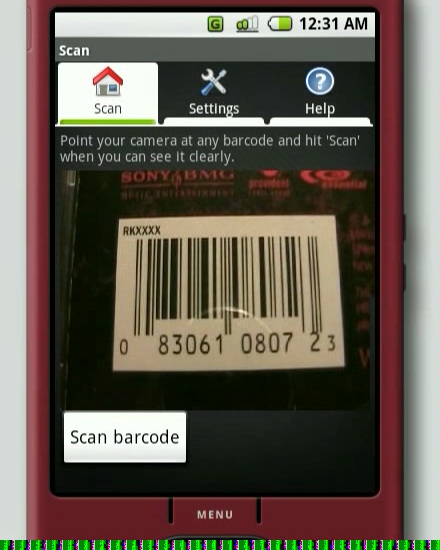
Android Scan

Scan is an Android application that finds pricing and metadata for anything with a barcode. Here are some key features that make Scan stand out:
  • Automatic barcode recognition using onboard phone camera using ZXing
  • Shows CD, DVD, or book cover along with detailed reviews from Amazon.com
  • Searches over a dozen stores, both online and brick+mortar
    • Highlights brick+mortar stores that are nearby, with option to call the store or get directions
    • Links to online storefronts to buy online from the phone
  • Tracklisting for CDs, along with option to play sample tracks right on phone
  • For books, searches local libraries to see if they have a copy
Very Cool. More information and a 3 minute video here.

The idea of using cellphones and bar codes to comparison shop and get additional information about products has been floating around forever, but this is the first time I have actually seen a working demo. The ZXing barcode scanning software is written in Java and is going to be ported to the iPhone, so hopefully applications like this will be available on all sorts of phones. I am particularly interested in seeing this technology leveraged for additional social and environmental information such as carbon footprints.

I haven't been very excited about Google's Android platform for phones, but if this is what the future holds in an Android world, I am all for it. For lots more cool apps that have been designed for Android click the link below.

via TechCrunch

Read More...

Wednesday, April 02, 2008

Carbon Footprint Jewelry

John Tierney suggests using jewelry to reduce carbon emissions.

I’d like to see a new green fad for electronic jewelry with real-time displays of carbon footprints. These could be mood rings, bracelets, lapel pins or anything else that could change color depending on how much electricity you use, how much gasoline your car burns, how much you travel.

The displays might change color from red to yellow to green as a carbon footprint diminishes. (There might even be a little glowing footprint on it.) The green might be a dim shade for those who have bought carbon credits to offset their energy use, but a much brighter shade for those who’ve reduced emissions to below-average without having to buy the credits.

Of course, it would be a chore to set up monitors for energy use, but plenty of greens are willing to give lots of time to the cause. Some are accused of being religious zealots — global warmists. But one of the advantages of religion is that it inspires people to acts of selflessness for the common good. Why not reward devout conservationists by letting them display their virtue?

This would be a strictly voluntary system — climate contrarians could either ignore it or proudly wear their flashing red lapel pins — and it would cost taxpayers nothing.

Besides putting the enthusiasm of greens to practical use, this fashion statement might also inject some realism into the debate about global warming. Once you start keeping track of all the energy you use, you begin to see the difficulties of making drastic reductions — and the difference between effective actions and ritual displays.

But I’m getting ahead of myself here. First, with your help (go to tierneylab.blogs.nytimes.com), we have to work out the details of this device, starting with what it should measure and what it would be called.

The Green Lantern is an obvious name, but there may be trademark problems. GreenGlow? Eglow? Enudge? The Nudgie? Further research is clearly needed.
I like that idea a lot. I am no fan of jewelry in general, but I could get down with this.

The problem is, where do you get the data from? Maybe you could just go to a website and fill in data to calculate your carbon footprint. But then, when would the bracelet change colors?

What I would really like would be if each merchant calculated the footprint for each product, and then passed this along to the credit card company. Then your credit card bill could specify the amount of carbon you have used along with the amount of money you have spent. This data could then be wirelessly transmitted to your carbon bracelet.

Until that day, I think it would be possible to get electronic data of carbon emissions via your monthly electricity and natural gas bills along with the gasoline and airline ticket purchases on your credit card. This would get the major energy components and carbon emissions. Your bracelet could be updated monthly to reflect your latest purchases.

Over at Earth2Tech they mention another way to use peer pressure to reduce your footprint: a Facebook App CarbonMinder that compares your carbon footprint with that of your friends.

via NY Times

Read More...

Friday, February 01, 2008

EVO

I recently came across the site EVO. I have been looking for a way to compare the environmental friendliness of products (similar to how I use CNET to compare electronic products) and EVO allows just that. They rate clothes, body and household products on a 1-5 leaf 'EVO rating' based on their environmental impact. More information about what EVO is all about can be found in this TreeHugger interview of their CEO.

While I like the concept, I think it needs a little refinement before I would use it.

First, it is not clear what they are basing their rating on. Why did one product get 2 leafs and another 4? They list lots of attributes that they base the rating such as energy efficient, organic, fair trade and lead-free, but they don't specifically say why each product got the rating it did. Environmental rankings are subjective, and I would like more information on exactly how why they ranked one product higher than another. If they made their analysis of the product available, this would make the recommendation much more valuable.

Second, when you are looking at a product, it would be helpful if they listed other products similar to it that have a higher EVO rating. Then you could easily compare products based on their environmental impact and find more environmentally friendly substitutions for products you are looking to buy.

Third, I wish they would allow user comments and rankings of products. Often times at CNET I find the user rankings to be more valuable than the CNET ranking. Users can help add information about a product that the site reviewers miss.

Fourth, what I would really like is if they made the information available via a plugin. Then when you are shopping at Amazon and other online shops, you could see the EVO rating of the product along with similar products that have a higher rating. I sketched out this envrionmental shopping plugin idea earlier.

I like the attempt this site is making, and hope that they make these changes so I can start using it to make more environmentally friendly purchases.

Read More...

Friday, November 16, 2007

How Green is My Purchase?

Just as food products are labeled with calorie and nutritional information, consumer products are beginning to bear details about their environmental impact, like the amount of greenhouse gases produced in making, transporting and selling them.

One is Timberland, which since last autumn has included a "nutrition label" with its footwear, detailing the energy used in making the shoes, the portion that is renewable, and the factory's labor record.
I am a big fan of adding these enviornmental labels to products to help customers see the impact of the products they purchase.

These labels are important because the environmental impact of products is not always obvious.
"We found that our supply chain goes farther than we imagined," Swartz said. "You have to go back to the cow" that supplied the leather.

Timberland was surprised to find that more than half of the energy used (and greenhouse gases generated) in making a pair of shoes comes from processing and producing the raw materials. The next-biggest energy drain is the retail environment (think of all those brightly lighted malls), followed by factory operations and, finally, transportation — almost a complete inversion of what Timberland had assumed.

"The vast majority of our carbon footprint comes before we even make the shoe," Swartz said.
Too often environmentalists come up with suggestions on how to change your behavior based on what intuitively sounds good (such as recycling or on buying local), rather than actually running a life cycle analysis to figure out where the largest impacts occur. Transportation of goods is often the target whereas this analysis shows that producing the product and the retail environment take up more energy.

While these labels are valuable to environmentally conscious customers in determining what to buy (or not to buy), these numbers are even more valuable to the managers of Timberland. When they see which steps have the largest environmental impact, they can focus on making improvements there.

Why aren't more companies creating these kinds of labels?
Timberland, like many companies, has hundreds of factory partners around the world, which use material from thousands of suppliers. It takes a large investment to collect such far-flung information.

Once companies understand what goes on in their supply chains, there are hundreds of calculations to be made. How much energy is used to transport a pair of shoes? That depends. Do you assume that the trucks are two-thirds or completely full? What kind of fuel do they use? And what about employee- commute miles? Should they be included, too?
It is expensive to calculate such numbers. It also takes lots of times to figure out how to handle all of those questions. That is why I believe you should support the companies that are making the effort by purchasing their products. Once a few companies have answered the questions and have collected the data throughout their supply chain, it will be much easier and less expensive for others to follow.

What information should be put on the label?
Timberland first relied on metrics from its global footwear production, so every pair of shoes displayed similar statistics: 3.1 kilowatt hours of energy to produce, 5 percent renewable energy used and no child labor.In

February, the company, which is based in Stratham, New Hampshire, introduced the next evolution of its labels, called green index tags, which move closer toward measuring precisely the effect of each pair of shoes. Instead of raw data, the tags use a scale of 0 to 10, with the bottom denoting the smallest impact (or best choice) on an expanded range of issues.

Climate effect is measured from raw materials through production of finished product. A 0 rating means that less than 4.9 kilograms of carbon equivalents were generated, while a 10 signifies 100 kilograms or more. (One hundred kilograms, or 220 pounds, is roughly the equivalent of burning 11 gallons of gasoline.)
This is tricky, as too much data can swamp the customer, too little and it might not be of any use. I am in favor of something simple at the top of the label, like the 0-10 rating they are using, so that a customer can easily see its overall impact, but then below it have more details for those that are really interested.
The information is not very useful, however, unless customers have something to compare it with. If a pair of Timberlands rates a 2 on climate impact, that is great. But how does it compare with your Nikes?

Timberland said it hoped to broaden its green index into an industry initiative. Swartz said that if he could sign up 10 or 12 companies, others might feel pressure to follow suit.
Ideally you want to be able to compare between companies which would require some kind of standards on how the numbers are calculated or independent verification from a 3rd party. Though, because there are so many assumptions used in calculating these values, at present it might be good to have many different types of analysis going on to get different opinions.

I applaud Timberland's effort and hope they are able to find another 10 companies to join in with them.

via International Herald Tribune via DailyGood

Read More...

Sunday, November 11, 2007

New Bar Codes Can Talk With Your Cellphone

The most promising way to link cellphones with physical objects is a new generation of bar codes: square-shaped mosaics of black and white boxes that can hold much more information than traditional bar codes. The cameras on cellphones scan the codes, and then the codes are translated into videos, music or text on the phone screens.

The wireless companies have other options to help cellphones interact with the physical world. They could, for instance, adopt image recognition software, which would allow phones to recognize anything — a Coca-Cola can, for example — and deliver related messages. Or, text messaging, currently the most common way that advertisers interact with consumers on their phones, has many advertiser applications.

Even if the wireless companies adopt the bar codes, they will have several formats to choose from. The most widely used ones have names like Semacode, QR Code and Qode.

In Japan, the codes did not become mainstream until the largest cellphone companies started loading the code readers on all new phones a few years ago. Now, millions of people have the capability built into their phones, and businesses, in turn, are using them all over — on billboards, street signs, published materials and even food packaging.

In Japan, McDonald’s customers can already point their cellphones at the wrapping on their hamburgers and get nutrition information on their screens. Users there can also point their phones at magazine ads to receive insurance quotes, and board airplanes using their phones rather than paper tickets. And film promoters can send their movie trailers from billboards. Hospitals put them on prescriptions, allowing pharmacies to instantly scan the medical information rather than read it. Supermarkets stick them on meat and egg packaging to give expiration dates and even the names of the farmers who produced them.

Advertisers say they are interested in offering similar capabilities in the United States, but cellphones in the States do not come with the necessary software. For now, consumers have to download the technology themselves.

Executives at Verizon, AT&T and Sprint declined to say whether they were in discussions with the companies that make the code reading technology. Bar code companies said the carriers stood to benefit from the codes because they might encourage consumers to add Internet service plans to their accounts and spend more time on their phones.
This is a cool technology that once again shows how far behind the Japanese the US is when it comes to cellphones and broadband.

I particularly like the idea of using this to get the environmental and social backstory of products. Imagine going to your local grocery store and getting additional information about the food you are buying. Or getting a video of how it was made. Or finding the amount of carbon emissions producing the item made.

Hopefully this technology will make it to the US and become widely adapted soon.

via NY Times

Read More...

Monday, October 15, 2007

The Economist on Carbon Labeling

The Economist takes a look at Carbon Labeling and some of its issues.

But calculating the carbon footprint of a product is far from easy. Unlike the fat or sugar content, it cannot be measured directly. For a start, how far back up the supply chain do you go? Academic “life-cycle analyses” go into painstaking detail, factoring in the emissions associated with building factories in which food is produced, for example. But doing this for thousands of products would be a mammoth undertaking. The trick, says Mr Murray, is to find the right trade-off between rigour and a methodology that works across thousands of items. The Carbon Trust's approach is to include carbon dioxide produced in the manufacturing but not, say, that from employees commuting to work.
I think that is true that it will be a massive undertaking, but once you have collected values for many of the underlying inputs to products, then calculating for a new product will not be that difficult.
How far down the supply chain do you go? The Carbon Trust's labels aim to show the carbon emissions associated with making something, packaging it, getting it to the store and disposing of it. Because bags of crisps delivered to far-flung shops will have travelled farther from the factory, the auditors use an average figure for transport emissions. Similarly, national averages feed into calculations of whether a product or its packaging are recycled, incinerated or put into landfill.

The labels do not count the energy needed for refrigeration, lighting and heating in shops. Nor do they include the emissions that come from using a product. The carbon footprint of boiled potatoes, for example, is dominated by the emissions associated with cooking them. Whether you put a lid on the pan can make more of a difference than how they were farmed, or whether they were produced locally or not. Similarly, the emissions of shampoo depend on how long you spend in the shower, how hot the water is and the quality of your boiler. Such things cannot be captured in a carbon label, so they are not included, says Mr Murray.
Interesting points on boiling potatoes and shampoo.

I think that adding carbon labels is a good thing to do, as emissions caused by our personal use of gasoline, natural gas and electricity only account for around 1/3 of our total emissions. The other 2/3 are embedded in the products that we purchase. Currently there is no way for educated consumers to figure out where that 2/3 comes from. If you add labels, then you could figure it out for yourself, and be able to shift your consumption to "low-carbon" products.

I also think that the improving the labels will be an evolutionary process. The first ones released will probably not be all that accurate, but hopefully in ten years time they will be pretty good.

via The Economist

Read More...

Friday, October 12, 2007

Buddhist Economics

The aim of Western economics is to maximize "standard of living" by the amount of annual consumption, with more being better.

The aim of Buddhist economics is to maximize well-being while minimizing consumption.

An industrial system which uses 40% of the world's primary resources to supply less than 6% of the world's population could be called efficient only if it obtained strikingly successful results in terms of human happiness, well-being, culture, peace and harmony.
This quote comes from Small is Beautiful (the current values for the US would be 25% of world's resources and less than 5% of population).

What are the implications of the Buddhist economics philosophy? What exactly is well-being and how do you measure it? What are the benefits of reducing natural resource usage? How does it change one's behavior as a consumer, as a worker and as an investor?

Lets take a closer look at these questions.


What is well-being and how do you measure it?

Adapted from Beyond Money:
  • Having a good life: a life that is enjoyable, meaningful, engaging, and fulfilling.
  • Having material well being: food, clothing, shelter, and medicine.
  • Having good health and a long life.
  • Having a good education and the opportunity to always be learning.
  • Having safety and stability at both the personal and larger community level.
  • Having good mental health: positive emotions, happiness, trust, optimism, and contentment.
Existing findings suggest the following partial formula for high well-being:
  • Live in a democratic and stable society that provides material resources to meet needs.
  • Have supportive friends and family.
  • Have rewarding and engaging work and an adequate income.
  • Be reasonably healthy and have treatment available in case of mental problems.
  • Have important goals related to one’s values.
  • Have a philosophy or religion that provides guidance, purpose, and meaning to one’s life.
Which country has the greatest level of well-being? What would be the impact of various policies be on well-being? Good statistics are required in order to answer these questions. GDP and GDP per capita are often used as a way of comparing well-being between nations and over time in a nation. But GDP per capita has many issues as a measure of well-being.

Mahbub ul Haq, Pakistani economist who pioneered the annual Human Development Index explains the difference between income and development as such:
The basic purpose of development is to enlarge people’s choices. In principle, these choices can be infinite and can change over time. People often value achievements that do not show up at all, or not immediately, in income or growth figures: greater access to knowledge, better nutrition and health services, more secure livelihoods, security against crime and physical violence, satisfying leisure hours, political and cultural freedoms and sense of participation in community activities. The objective of development is to create an enabling environment for people to enjoy long, healthy and creative lives.
To measure well-being, what kind of attributes should we be collecting statistics on?

On the individual level, examples include: health, education, material well-being and quality of work. Additionally from a mental perspective: positive and negative emotions, depression, engagement, purpose and meaning, optimism and trust, and the broad construct of life satisfaction.

On the societal level examples include: life expectancy, literacy rate, unemployment rate, homelessness rate, crime rate, suicide rate, marriage and divorce rates, bankruptcy rates, community vitality, citizen engagement, environmental quality, land set aside for nature, amount of natural resources used, and stability of government.

There are many examples of statistics measuring different aspects of well-being. In the US, Redefining Progress calculates the Genuine Progress Indicator (GPI) which distinguishes worthwhile growth from uneconomic growth by subtracting the negatives out of GDP such as resource depletion, crime and family breakdown. Ed Diener and Martin Seligman are creating a national well-being index looking at positive and negative emotions, engagement, purpose and meaning, optimism and trust, and the broad construct of life satisfaction. The Calvert-Henderson Quality of Life Indicators look at education, employment, energy, environment, health, human rights, income, infrastructure, national security, public safety, re-creation and shelter.

Many other countries have their own metrics. Bhutan has a Gross National Happiness statistic. The EU monitors psychological well-being with the Eurobarometer. All regions of New Zealand submit regular reports on their environmental, social, cultural and economic wellbeing. Canada is working on an Index of Well-being. The UK's conservative party suggests scrapping Gross Domestic Product (GDP) as a measure of the nation’s success in favor of a model that measures people’s happiness drawn up up by Friends of the Earth.

There are also some statistics collected comparing well-being between nations. The UN developed the Human Development Index (HDI) ranking countries by life expectancy, literacy and GDP. The World Value Survey has assessed happiness and life satisfaction in about 70 nations. The OECD is working toward metrics on well-being and societal progress. WWF has graphed HDI with ecological footprints as a way of looking at both development and resource usage.

While well-being is easy to describe, it is difficult to measure. But good measurement is necessary to determine how countries are doing. While GDP and GDP per capita are easy to measure, they are an inexact proxy for well-being. Current well-being measurements are still a work in progress and are steadily being improved. While they might not be as accurate as one would wish, as Keynes said "It is better to be roughly right than precisely wrong".


Why minimize natural resource use?

Buddhist economics attempts to minimize consumption (natural resources). There are four main reasons to minimize natural resource consumption.

First, using less leaves more for others. Reducing our consumption of natural resources ultimately allows the the size of the human population on Earth to be larger and more people experiencing a quality life is a good thing. By not using natural resources, you allow them to be used by someone else. As can be seen in a standard supply/demand diagram, lowered demand reduces the price for everyone. Those with the least will be able to afford more.

Second, natural resource usage leads to pollution and environmental damage. Fossil fuel usage leads to greenhouse gas emissions which lead to global warming. Fertilizer and pesticide runoff from agriculture pollutes rivers. Mining removes entire mountains and pollutes surrounding rivers with runoff and toxic chemicals. Limiting natural resource usage reduces these environmental damages.

Third, it allows more room for nature. Less land for farming, less land for tree harvesting, and smaller cities means more land for wilderness. Many species are being driven to extinction by human encroachment. Increases in agricultural land in Brazil are causing the Amazon rainforest to be cut down. And as stated above natural resource usage means leads to pollution which is also not good for wild animals.

Forth, natural resource extraction often leads to corruption and violence. While you would think discovering natural resources in a poor country would lead to economic development, in fact the opposite is likely to occur, a phenomenon known as the natural resource curse. One variety is the oil curse which has afflicted many countries including Azerbaijan, Angola, Chad, Russia, and Iraq. Blood diamonds are used to support wars in Africa. Forests in Burma are cut down to support the military dictatorship. While these problems do not typically afflict first world countries, using fewer of these natural resources decreases demand, lowering the global price and giving less money to the offending regimes (and making it easier to boycott goods from them completely).


How should one consume?

While Western economics aims is to maximize consumption, Buddhist economics aims to maximize well-being from our consumption while minimizing the natural resources they took to produce.

Buddhist economics is about maximizing the well-being return on natural resources of every purchase. The first way to do this is to add more meaning to each of your purchases. Items given as gifts often have additional sentimental value. No additional natural resources are need, but it adds to your well-being.

The second way is to decrease your natural resource usage while maintaining your well-being. This is done by minimizing the Material Intensity Per Service Unit of your purchases. It means shifting your purchases to products and entire segments of the economy that use fewer resources, purchasing more services and less goods, and substituting virtual goods for real items. Examples include: substituting video conferencing for air travel, vacationing closer to home, purchasing a fuel efficient car, and eating more vegan food and less meat.

Buddhist economics is a philosophy of better not more. Instead of trying to eat the most you can without getting fat, you want to eat the least you can while still thoroughly enjoying your meals and maintaining your health. In the US so much food is consumed that it has a negative impact on health. Well-being in the US could be improved if Americans shifted their consumption to a lower quantity of higher quality foods.

Rather than purchasing inexpensive items that would need to be replaced many times, you want to spend extra for higher quality goods that last longer. You also want to make your purchases last as long as possible and then, if feasible, find a new home for them when you no longer use them. Another way to get the most out of natural resources is to rent goods or share a purchase with multiple people, such as with car sharing or eBay renting.

Buddhist economics is about substituting human ingenuity for natural resources: cars that get higher gas mileage, houses that are designed to use less energy to heat, or computers that need less electricity to run. It is about paying more for items that use less natural resources (like hybrid cars and CFL light bulbs), or use renewable resources in place of non-renewable resources (like green electricity that comes from the wind rather than coal).

It is a philosophy of voluntary simplicity. Instead of trying to buy the largest house you can afford, it is about trying to find the smallest house you can live in and still be completely satisfied. Fight Club summed it up best: the things you own end up owning you. Owning more means spending more time cleaning, maintaining and fixing things. Instead of enjoying our things they become a source of work and headaches. Streamline what you own to just what gives you the most happiness and well-being.

Buddhist economics is about maximizing well-being through smart consumption. Many aspects of happiness and well-being are counterintuitive and we need to adjust our purchases accordingly. One example is that people tend to adapt to improvements in goods and no longer get additional happiness from them, but they don't take this into account during purchasing. While an HD TV at first is breathtaking, after enough views the quality of the picture will be taken for granted. In the Happiness Hypothesis, Jonathan Haidt says that we will adapt to power, status, freedom, health, and sunshine but not to (street) noise, commuting, lack of control, shame, or relationships (interpersonal conflict). Spending more of our money on purchases we don't adapt to will increase well-being. Variety is the natural enemy of adaption, and adding it to our purchases increases our enjoyment.

Also:
Considerable evidence suggests that if we use an increase in our incomes, as many of us do, simply to buy bigger houses and more expensive cars, then we do not end up any happier than before. But if we use an increase in our incomes to buy more of certain inconspicuous goods–such as freedom from a long commute or a stressful job–then the evidence paints a very different picture. The less we spend on conspicuous consumption goods, the better we can afford to alleviate congestion; and the more time we can devote to family and friends, to exercise, sleep, travel, and other restorative activities.
The more we can substitute inconspicuous goods for conspicuous ones, the more well-being we will get out of our purchases.

In order to minimize your natural resource usage, you need to be able to track it. It would be great if there was a Quicken like piece of software which could track the natural resource expenditures of all of your purchases. Every time you used your credit card, information on what you purchased and what natural resources it required would be recorded and later download into the Quicken like software. Ideally, it would measure many different types of natural resources: land usage, water, metals, minerals, energy, CO2 emissions and pollution. With this knowledge you could then try and adjust your purchases to lower natural resource consumption each year while maintaining your well-being.

Having so many different types of natural resources makes it difficult to determine how best to minimize your usage. One solution is to aggregate them into a single score using a weighing mechanism such as Ecoindicator '99.

Another way to aggregate the natural resource consumption is the Ecological Footprint measurement. It looks at the amount of land needed to provide the resources required to manufacture the good and to absorb its wastes. Hopefully in the future grocery stores will have environmental rewards cards that track the footprints of all your food purchases. It would be even more useful if it split the footprint into energy and land usage components as acres and gallon scores. The footprint concept is good but currently there are some methodology issues with how it handles energy use and increased productivity of land meed to be addressed for its results to be accurate.

Buddhist economics is concerned about the well-being of future generations and therefore supports sustainability. It seeks to eliminate the non-sustainable use of resources such as fossil fuels, clear cutting of forests, depleting aquifers, soil loss due to farming, and over harvesting of fish stocks. It seeks to maximize use of recycled goods to minimize the need for additional mining or harvesting of forests. It even seeks to minimize sustainable use of natural resources as this allows others to substitute their non-sustainable resource usage for a sustainable one.

Buddhist economics takes into account the well-being of others as well as yourself and supports good jobs for workers. You want your purchases to make the largest positive impact on the workers, possibly by supporting higher wages for workers or possibly by supporting workers in poor countries where additional money would go farther. As consumers we should try and support products that generate good jobs and likewise avoid products that lead to bad jobs.

Buddhist economics is about taking the entire backstory into account instead of just purchasing based on price and quality. What kind of jobs did my purchase support? What impact on the environment did it have? If you get a good deal but it comes at the expense of workers or the environment, then it is not a good deal.

Improved labeling helps us to better see the backstory. There are more and more examples of environmental and social labeling appearing every day. The Fair Tracing Project is developing a digital tag that would tell the backstory behind the food you eat, and the Dole Organic Farm label allows you to view the farm the banana was raised on and certifications of that farm. Green Office has a "green screen" which rates products based on the amount of recycled content they contain, their biodegradability, their chemical content, and third party verification of products and companies. JVC Manufacturing's label shows energy usage, CO2 emissions, water usage, air and water pollution, chemicals used and waste created. Carbon labeling by Carbon Trust and Tesco calculate the CO2 impact of items like potato chips. Timberland has a "Our Footprint" label, Home Depot has an Eco Label and Wal-Mart is adding an environmental sustainability scorecard to electronics. The Hekhsher Tsedek label ensures workers of kosher foods are treated fairly and Fair Trade sets standards for international labor and environmentalism.

Hopefully in the future, customers will be able to use their cellphones to access this information about products they are purchasing like they do in Japan.

In conclusion, consumption in Buddhist economics is about maximizing the well-being return on natural resources, substituting human ingenuity for natural resources, maximizing well-being through smart consumption, taking the entire backstory into account, and supporting good jobs for workers. It is a philosophy exemplified by the concepts of better not more, voluntary simplicity, and sustainability.


How about work?

From Small is Beautiful:
To strive for leisure as an alternative to work would be considered a complete misunderstanding of one of the basic truths of human existence, namely that work and leisure are complementary parts of the same living process and cannot be separated without destroying the joy of work and bliss of leisure.

Whereas the goal of Western Economics is to minimize and hopefully eliminate all work, Buddhist economics sees that having a good job is a necessary component of well being, and as a goal to create good jobs for everyone.
While GDP goes up the more you work, at a certain point individuals would get greater well-being from more leisure than from additional income. Overwork leads to stress and illness, decreasing well being as this research finds:
Despite the weak relationship between income and global life satisfaction or experienced happiness, many people are highly motivated to increase their income," the study said. "In some cases, this focusing illusion may lead to a misallocation of time, from accepting lengthy commutes (which are among the worst moments of the day) to sacrificing time spent socializing (which are among the best moments of the day).
And while not having a job might sound ideal, it has negative impacts on well-being as well. From Reality Check:
But unemployment brings just as many health problems and hidden costs as overwork. The unemployed suffer higher rates of physical and mental illness than those with jobs.

Attributes of good jobs:
  • Meaningful to worker
  • Opportunity for using skills and creativity
  • Variety of tasks
  • Respect and status
  • Interpersonal contact
  • Opportunity for personal control
  • Limited stress and safe
  • Good pay and benefits
In The Happiness Hypothesis, Jonathan Haidt states that work at its best is about connection, engagement and commitment.

Po Bronson writes in What Should I Do With My Life that:
We still cling to the idea that work should not only be challenging and meaningful -- but also invigorating and entertaining. But really, work should be like life: sometimes fun, sometimes moving, often frustrating, and defined by meaningful events. Those who have found their place don't talk about how exciting and challenging and stimulating their work is. Their language invokes a different troika: meaningful, significant, fulfilling. And they rarely ever talk about work without weaving in their personal history.
Instead of striving for jobs with the highest pay, we should strive for those that give us the greatest increase in well-being, opportunity to display our talents and allow us the greatest potential to improve the world.

Being selective as to where you work can have an impact on companies as well. Jeffrey Sachs says that businesses can't recruit top talent anymore unless they are doing corporate philanthropy. The first thing many candidates ask is what the company is doing in Africa. These recruits want to work at a place that is meaningful, a place that is making contributions to do good in the world. For corporations then philanthropy and doing good make business sense in order to attract top talent.

The term "good job" is too often defined solely by its salary. Boring, repetitive manufacturing jobs are considered good because they pay well and have good benefits. But, while they capture the last bullet point for attributes of a good job they often miss all the others. These jobs frequently pay well to compensate for the fact that the others are lacking. Jobs should be redesigned to meet all the bullet points and ones that can't make it should be eliminated. Boring repetitive work should be outsourced to computers and machines, and the interesting and challenging part should be left for humans.

As a society (and as consumers) we should try to give everyone the opportunity to work and make jobs as good as possible. While all jobs can't pay well, they can meet the other conditions of being a good job. If a job is made better but not more productive, this isn't captured by traditional economic metrics, but it is still a good thing. We want an economy that allows as many people as possible to follow their dreams and get paid to do it full time. GDP might not be affected, but well-being would be increased if more people can pursue professions they are passionate about.


What about investing?

Western economic investing allocates capital to maximize return on investment while Buddhist economics takes additional social and environmental issues into account.

If you are following Buddhist economics principles, your self-worth is not based on the size of your bank account and you are attempting to minimizing your consumption. Therefore, while you will still need to invest for retirement, for financial security, and for large purchases, your overall need for wealth will not be that great (then again, you might take a job that pays less, so you will have less to invest in the first place). You will likely have more money then you will consume yourself and the extra money will be given away. Accordingly, you are not solely focused on maximizing returns and are able to take other social and environmental issues into account when investing. Just like you are willing to spend more for socially/environmentally conscious products, you are also willing to accept a lower return on investment for companies that handle more than their fair share of social and environmental issues.

Buddhist economics investing is about long term, non-zero-sum game investing. Short term investing, such as day trading, is more gambling than investing as one person has to lose money for another to gain. From a societal standpoint this is a waste of time, as all the effort of the investors goes into trying to outsmart their competitors rather than creating new wealth. Since you are concerned not just about maximizing your own wealth but also about societal well-being, you want to avoid short term zero-sum game investing.

Universal investing is one form of long term investing where you invest as broadly as possible in the world economy. A universal investor therefore aligns himself with what is best for the entire world economy over the long run.

Investing can also be an alternative to donating money to non-profits. It is more effective to invest in a company that is less profitable because it is stopping problems from ever occurring than to donate to an NPO to help fix the problems that were created.

For example, suppose there are two companies, one which would give you a slightly higher return (say 10%) but have higher environmental costs (for example, coal companies with air pollution) and another which has a slightly lower return (say 8%) but fewer environmental costs (solar power). You can think of the 2% lower rate of return as a donation. But, this "donation" is likely to have much greater impact than donating to a charity, for it is stopping the environmental and health issues of coal, such as asthma and respiratory diseases, from ever happening rather than donating to an NPO to provide medicine to fix the problems it caused.

Loaning can have a greater impact than giving. You can only give your money away once, but if you loan it out instead it comes back and then you can loan it out another time (and on and on) greatly increasing its leverage. One way is through microfinance where you loan to someone in the 3rd world who wouldn't have access to capital otherwise. Created by Grameen bank, microfinance is now prevalent and anyone with $25 and internet access can be a banker to the poor via kiva.org. Because a small amount of money has a larger impact to someone in the 3rd world than in the 1st, microfinance's impact on well-being is greater than a similar amount invested in the first world.

Investing in 4th sector companies, those that are run for-profit but with a nonprofit mission, can have a greater impact than donating to a non-profit. They are more sustainable than non-profits as they fund themselves through their business and are not dependent on fundraising to cover their expenses. For example, the Greyston Bakery employs those recently released from jail and gives them the opportunity to gain job skills and increases their employability. If an NPO attempted to teach the job skills instead, it would cost money to run, requiring donations, and the opportunities of the workers wouldn't match that of being on a real job.

Buddhist economics is about getting companies to think long term. This really is no different from Western economics as the best companies (such as Google) and investors (Warren Buffet) think long term, but not all companies do. Managers at many firms are focused on short term goals to the detriment of the longer term. Long term focused companies are ethical, honest and act legally as to not do so will severely damage companies in the long term. One take on corporate social responsibility (CSR) is just to get a company to think in its enlightened long-term self interest.

You also want companies to internalize the externalities. An externality is a positive or negative impact on anyone not party to a given economic transaction, in this case a social or environmental impact that goes beyond the company and the consumer.

Examples of negative externalities include: pollution, clearcutting forests, exploiting workers, and greenhouse gas emissions. Examples of positive externalities include: hiring workers that are otherwise unemployable, creating knowledge through R&D (that isn't covered by patents), improving safety for workers, and providing access to credit to those that otherwise wouldn't get it.

While a smart, long term focused company can internalize many externalities without additional costs, at some point there is a trade off between externalities and profitability. The costs can be absorbed by consumers in the form of higher prices, workers in the form of lower salaries, or investors in the from of lower returns. As seen above, it is cheaper from society's standpoint for a company to handle the externalities itself rather than having citizens pay more in taxes or donations to fix the problem later. Therefore you want to support companies that internalize their externalities even if this leads to a lower rate of return.

To see which companies are handling their externalities, Buddhist economics is about supporting corporate transparency and greater environmental and social reporting. Instead of just reporting about the bottom line, you want companies reporting about the triple bottom line: "People, Planet, Profit". The additional information allows you to value them on more than just profits.

Many corporations are already doing this as shown by the 2271 CSR, Sustainability, and Environment reports released in 2006 as tracked by Corporate Register. In order that these reports can be compared with each other, the Global Reporting Initiative specifies a set of reporting guidelines.

Making this information available allows non-profits and financial institutions to compare companies. For example, Climate Counts ranks companies based on carbon reporting and actions being taken, Greenpeace has a Green Electronics Guide that ranks leading mobile and PC manufacturers on their global policies and practice on eliminating harmful chemicals and on taking responsibility for their products once they are discarded by consumers and Goldman Sachs, the Wall Street investment bank, has a four-member research team that assesses the environmental, social and management performance of companies in the same way that more traditional colleagues analyze financial performance.

You can get companies to think long term, internalize the externalities and support transparency by rewarding companies that do this with higher valuations and by putting pressure on companies that don't to move in the right direction.

Instead of basing the value of a company on just its earnings you want to add in additional social and environmental externalities. If a company is making $2 a share but has positive social and environmental externalities that equate to an additional $2 a share, then you want to value this company as if it was earning $4 a share. Taking these positive externalities into account will cause the company's stock to go up and have a higher P/E ratio. This increased price gives an incentive to managers of competing companies to change their behavior so they too will get the premium put on their stock.

The increased price also means more capital is allocated these companies and it signals others to invest in similar companies or to create new companies like them. For example, because cleantech companies are currently being given high valuations, venture capitalists have more incentive to fund cleantech companies. Between 2005 and 2006, investments in the clean-tech sector jumped from $623 million to $1.5 billion.

Alone you might not have much impact on a stock price, but by banding together with like minded investors, you can make a big difference. One such way is investing through socially responsible investing (SRI) mutual funds which aim to maximize both financial return and social good. Today, $2.3 trillion, nearly one out of every ten dollars under professional investment management in the United States, is involved in SRI.

While it is possible to raise a stock price to reflect the positive externalities a company brings, it is not possible to do the opposite and lower the stock price of a company that has negative externalities as long as some investors value companies only on earnings. To nudge bad companies in the right direction you need other techniques.

Ownership can be used to influence companies:
"Responsible investing requires responsible ownership," said Amy Domini, Founder and a Managing Principal of Domini Social Investments. "By filing shareholder proposals on social and environmental issues, and through constructive dialog with companies, we are helping to make corporations more accountable to their stockholders, employees, communities and the environment."
Another possibility would be to take a company private. A SRI private equity firm could be created that looks to purchase social and environmental laggards in hopes of reforming them. For example, a coal company that uses inefficient and polluting power plants could be bought out completely. The plants could then be replaced with more efficient IGCC versions which also remove 90-95% of mercury, and greater than 99% of sulfur dioxide (SO2). The CO2 could be captured and sequestered. Looking strictly at the bottom line this sort of purchase might not make sense, but if investors are motivated by improving the environment as much as making money and see the transaction as part donation, part investment, then it does.

While it might seem counter-intuitive to invest in "bad" companies, they have more potential for change, as the "low hanging fruit" that other companies have already picked are still available. It is easier to make a positive impact for the environment by working with Wal-Mart than it would be with Whole Foods, since Whole Foods has already implemented many of the changes and Wal-Mart is a larger company so the impact would be greater.

Some ethical investors use screens to avoid investing in certain companies that produce products that society would be better without such as alcohol, tobacco and weapons. But, not investing in these companies does nothing to reduce demand for their products or make them go away. If ethical investors shun these companies they would be owned solely by people looking to maximize profits regardless of externalities who see no reason to change.

Instead, while people are still purchasing these products, you want to use your influence as an owner to make sure those companies are producing them in the most responsible way possible. As long as people are still smoking, you want tobacco companies to do their best to stop underage smoking, make cigarettes that are as easy as possible to quit and attempt to create electric toxin free cigarettes. You want alcohol companies that don't target teenagers with their advertisements.

Another way you can change these companies is to change their definition of their business. For example, getting oil or coal companies to think of themselves as energy companies, where the energy could be generated in a more environmentally friendly way.

To summarize, Buddhist economics investing is about long term investing and using investing as an alternative to donating. It is about trying to get companies to think long term, internalize externalities and practice transparency by supporting good companies and nudging bad ones in the right direction.


Conclusion

While Western economics attempts to maximize standard of living, Buddhist economics attempts to maximize well-being. Whereas Western economics is agnostic toward natural resource use Buddhist economics attempts to minimize it. The key reasons for decreasing resource use are: leaving more for others, reducing pollution and environmental damage, leaving more room for nature and reducing corruption and violence. The point of the economy is more than just maximizing output or productivity, it is to create meaningful jobs that create the goods and services that allow us to maximize well-being.

As individuals, Buddhist economics changes the way we consume, work and invest. Consuming is about maximizing well-being while minimizing natural resources usage. Working is about finding the job that gives us the most well-being, the best opportunity to display your talents and the greatest potential to improve the world. Investing is about long term investing and using investing as an alternative to donating.

Some people like to blame society's problems on corporations. If only corporations cared about more than just maximizing profits then many of the worlds problems wouldn't exist. If we could just get corporations to change, the thinking goes, then these problems would be solved. But, the way a corporation acts is determined by the values of its customers, workers and investors. If a company's customers are just looking for the lowest price, its workers just looking to maximize their salary and its investors just trying to maximize their return, then you will find a company that is not concerned about greater social and environmental issues. If you forced that company to make changes but their customers weren't willing to pay more, they would just go to a competitor, the company would flounder and no real change will have taken place. Likewise, a company whose customers, workers and investors take greater social and environmental issues into account will be able to focus on more than just the bottom line. Therefore to enact change, instead of targeting the managers of a corporation, the key is getting its consumers, workers and investors to change.

As a society, Buddhist economics changes the way we measure success. Instead of using GDP as the measure of progress, you use statistics on the well-being of society. It has been reported that:
In the early stages of a climb out of poverty, for a household or a country, incomes and contentment grow in lockstep. But various studies show that beyond certain thresholds, roughly as annual per capita income passes $10,000 or $20,000, happiness does not keep up.
Once an economy gets to a certain level, mental impacts of well-being are much more important than the ability to obtain more stuff. At this level certain policies, such as reduced work hours or greater environmental regulation, that reduce GDP might actually raise well-being. At the societal level, natural resource use can be discouraged by taxes on resources such as taxes on carbon and mineral extraction.

The Buddhist economics philosophy works well within a democratic capitalist system. Individuals have the freedom to choose how they consume, work and invest. They are able to vote for the politicians that would best follow its principles. They are free to lobby and convince their fellow citizens to follow these principals as well.

Read More...

Tuesday, October 02, 2007

Does Anyone Read Nutritional Labels?

I am a habitual reader of nutritional labels, but I have been curious whether my actions are an abnormality.

WN: What about food labels? Are they helpful?
Wansink: In every study we do, regardless of what focus is, there's about 15-20 percent of the people who look at the food label and read it and process it accurately. Of course, 70 percent of people say they do, but they don't.
Looks like I am in the minority.

I have been calling for social and environmental labeling to be added to products. If they were, I bet the same 15-20% of people would actually read them.

via Wired

Read More...

Sharp Shows Off Multi-Touch Optical Scanning Portable LCD

Today at CEATEC Sharp showed off its optical scanning LCD -- a 3.5-inch 320 x 480 portable display with an optical scanner integrated into each pixel, making the screen capable of scanning business cards and other visual information placed on its face. The pixel-integrated optical scanning technique is also able to be used to enabled more robust multi-touch interfaces; instead of a touch-sensitive film (like most touchscreen phones) or a capacitive display (like on the iPhone), these future Sharp displays literally constantly scan for finger touches, enabling multi-touch input with all five fingers simultaneously.
Pretty slick to allow the screen of a cellphone to also be a scanner. I think this would be good for being able to scan the barcodes of items while at a store to get additional information on the item such as environmental impact or comparison pricing.

via Engadget

Read More...

Tuesday, September 25, 2007

Wal-Mart Asks: How Much Energy Does it Take to Make Toothpaste?

Wal-Mart Stores Inc. (WMT) on Monday said it formed a partnership with the Carbon Disclosure Project to measure the amount of energy used to make products throughout its supply chain.

Wal-Mart said it will use this measurement tool to initiate a pilot plan with a group of suppliers to look for new and innovative ways to make the entire process more energy efficient.

The pilot will focus on seven commonly used product categories - DVD's, toothpaste, soap, milk, beer, vacuum cleaners and soda - and seek to determine the overall environmental impact of products and look for innovative ways to drive energy efficiency.
Interesting. I like it. Can't wait until the day that the labels at the store include the environmental impact of each item.

The project plan of calculating one item in many categories makes a lot of sense to me, but I don't get why they are doing both beer and soda. They are quite similar from an environmental standpoint. Would have liked to see something wood based, maybe books or furniture. And while a vacuum cleaner hits the electronic goods category, I would rather see a TV or a computer in this category.

via CNN Money via Earth2Tech

Read More...

Monday, June 25, 2007

Climate Counts

Today marks the launch of Climate Counts, a new nonprofit initiative to rate major consumer brands on their climate commitments and performance.

The data released today rate 56 companies on a 100-point scale based on more than 20 criteria in four categories:

* How well does the company measure its climate footprint? (up to 22 points)
* How much has the company done to reduce its global warming pollution? (up to 56 points)
* Does the company explicitly support (or express intent to block) progressive climate legislation? (up to 10 points)
* How clearly and comprehensively does the company publicly disclose its climate protection efforts? (up to 12 points)

You can view and download the scorecard and its criteria here [PDF].
I like this idea. I think the scoring metrics make sense, and this labeling technique will put pressure on companies to become more transparent about their footprint and what they are doing about it.

But, I am going to give the companies time to respond before taking the actual results seriously. For example, Google doesn't score very high, and yet with their solar power project and other initiatives to use renewable power, they do seem to be taking global warming seriously and doing something about it. In a year or two, I bet they will have made that information public in the format that Climate Counts is looking for. At that point I will start taking the rankings into consideration when making purchases.

via GNET

Read More...

Sunday, May 20, 2007

Fair Tracing Project

The Fair Tracing project at Britain's University of Bradford is developing a digital tag that would tell the backstory behind your bananas--or your coffee or chocolate. As food makes its way to your plate, growers, refiners, exporters, and retailers could upload information about their role in the supply chain. That text, audio, and video could connect consumers with an otherwise anonymous gastronomic universe.

Apurba Kundu, who leads the Fair Tracing project, and his team have created a crude demo version that relies on bar codes--but the final technology could take the form of a radio-frequency-identification system or, more simply, a unique number printed on the label. They've partnered with Ehrmanns, a UK importer of fair-trade wine; we could see the first tagged bottles by next spring. If it works, shoppers will punch numbers into their cell phone or PDA right in the store, or on their computer back home.
I like this idea and hope that it goes far.

via Fast Company

Read More...